
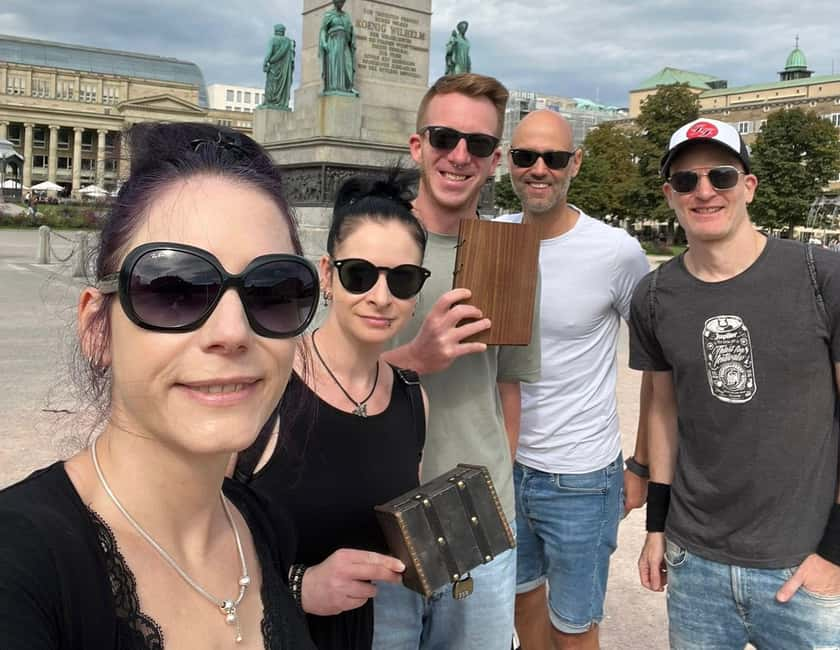
Review · BADEN-WüRTTEMBERG
Stuttgart: Outdoor Escape Game – exciting puzzle tours about the city’s history
Stuttgart hides clues in plain sight. This outdoor escape game turns the city center into a playful history lesson, sending you through streets, squares, and historic sites with a puzzle book in hand. I like the personal welcome from historian Michael Mezger and the freedom to pause for coffee, cake, or an ice cream. The main drawback is that the experience is conducted in German, so it may not suit visitors who cannot follow German instructions.
I also like the choice between two adventures. The Wilhelm Case is the gentler starting point for families and first-time players, while The Case of Max von Bulsenberg offers harder puzzles for experienced escape-game fans. There is no countdown clock, which keeps the mood relaxed, but you should still allow a full two to three hours.
Key details before you book
- Start and finish at Schlossplatz: Meet at the Jubilee Column, a central spot that is easy to reach by public transport.
- Two difficulty levels: Choose The Wilhelm Case for an approachable game or The Case of Max von Bulsenberg for a more demanding challenge.
- History comes with every puzzle: The book combines codes, logic tasks, creative challenges, and facts about Stuttgart and Württemberg.
- No race against the clock: You can stop for a drink, take a break, and continue at your own pace.
- Suitable for groups up to 30: Larger parties are divided into teams playing the same adventure together.
- Bring a charged phone: You need a smartphone with internet access, especially for The Max Case.
Starting at Stuttgart’s Schlossplatz
The game begins at the Jubilee Column on Schlossplatz, one of the easiest places in central Stuttgart to find. It is also a practical meeting point if your group is arriving by tram or train connections, and several parking garages are nearby.
Your introduction comes from Michael Mezger, a historian who welcomes you in person and explains how the game works. That opening matters more than it may sound. Outdoor escape games can be confusing if you are simply handed a booklet and sent off, but a short briefing gives your group a clear sense of the rules and the kind of clues to watch for.
The same location serves as the finish point. After the game, you meet Michael again to go through the solutions, compare approaches, and ask questions about Stuttgart’s past. This gives the activity a proper beginning and ending instead of leaving you to wander away once the last answer is found.
The meeting point is also useful for planning the rest of your day. You can arrange the game around time in the city center, then continue sightseeing from Schlossplatz without having to cross town.
More Outdoor Escape Games in Germany
- Bamberg: Outdoor Escape Game with a Puzzle Backpack
★ 4.8 · 101 reviews - Bremen: Outdoor Escape Game in the Old Town
★ 4.4 · 41 reviews - Dresden: Krimi Outdoor Escape Game “Mord am Elbufer”
★ 4.9 · 29 reviews
Choosing between the two Stuttgart cases
The first decision is not about timing or group size. It is about difficulty.
The Wilhelm Case is designed as the introduction to the series. It is aimed at beginners, families, and anyone who likes solving problems without being pushed into an expert-level challenge. The puzzles are described as manageable for children, and the lack of time pressure makes it easier for a mixed-age group to work together.
That makes it the safer choice for a family or a group with different puzzle skills. Younger players can help spot details and work through simple clues, while adults can handle the parts that need more reading or careful logic. The activity is not just a children’s game, though. Adults who enjoy city stories and light puzzle solving should still find enough to keep them involved.
The Case of Max von Bulsenberg is the tougher option. It is intended for people who already enjoy escape games and want a more involved challenge. You need a mobile phone for this game, so check that your device is charged before setting out.
The descriptions do not provide a precise age range or explain every difference between the two routes. If your group is undecided, The Wilhelm Case is the better pick for a first attempt. Choose the Max case only if your group would rather wrestle with a difficult clue than breeze through a straightforward one.
Following clues through Stuttgart’s center
Once you receive the puzzle book and game materials, you head into Stuttgart’s streets, alleys, and squares. The route includes familiar sights and lesser-known stops, so the activity works as both a city walk and a game.
The exact sequence of locations is not provided in advance, which is part of the fun. You are not simply following a guide from one landmark to the next. Instead, each location gives you something to examine, interpret, or connect with the next part of the story.
Some clues are printed in the book. Others are tied to buildings and public squares, which encourages you to look carefully at the city around you. A doorway, inscription, architectural feature, or public detail can become part of the answer. You will need to balance reading with observation, rather than keeping your head down over the puzzle book the whole time.
The route links present-day Stuttgart with stories from Württemberg and the city’s past. The historical information is designed to be read as part of the game, so you get short facts and surprising details without sitting through a formal lecture.
That format is especially useful if you find ordinary sightseeing tours too passive. You have a reason to pay attention. A historic place is not just a backdrop for a photograph. It becomes part of the problem your group is trying to solve.
What solving the puzzles is actually like
The challenges include logic problems, codes, and creative tasks. Some appear in the puzzle book, while others are connected directly to buildings and squares.
You may find that different people in your group contribute in different ways. One person may be quick with numbers or patterns. Another may notice a detail on a building. Someone else may be better at reading the historical information and connecting it to the clue. This makes the game a good fit for families and friends who enjoy working as a team rather than competing individually.
The lack of a countdown is one of the strongest features. You can stop for coffee and cake, take a breather, or spend extra time at a historic stop. One person described having enough time for a café break during the game, and that is a useful clue to the pace. You are not expected to sprint from answer to answer.
That relaxed format has a tradeoff. If you enjoy the adrenaline of a timed escape room, the outdoor version may feel less urgent. The challenge comes from solving the clues and noticing the city, not from racing the clock. For most groups, that is a fair exchange because you can enjoy Stuttgart rather than treat the streets as a running track.
Same place, a different puzzle:
- Hamburg: Treasure Hunt Game through HafenCity
★ 4.7 · 364 reviews - Hamburg: Scavenger Hunt Self-Guided Tour for Children
★ 4.5 · 319 reviews - Treasure Hunt through Hamburg’s Hafencity
★ 5.0 · 234 reviews - Escape Room Adventure in Berlin Solve the Mystery
★ 5.0 · 222 reviews
The historical side of the game
The history here is delivered in small portions. You learn about Stuttgart and Württemberg through facts connected to the route and the puzzles, including details that are easy to miss during a standard walk through the center.
I like this approach because it gives information a clear purpose. You are more likely to remember a fact when it helps you solve a code or understand why a particular place matters. The puzzle book also gives you something tangible to keep using during the activity, rather than relying only on spoken explanations.
Michael Mezger’s role adds a human touch. He welcomes you at the start, explains the game, and returns at the end for the discussion. You can ask about the puzzles and the historical points that caught your attention. For anyone curious about Stuttgart beyond its main sights, that final conversation is an important part of the experience.
The booklet is described as lovingly designed, with both tasks and historical facts. It is returned after the game along with the other materials, so do not plan on taking it home as a souvenir.
A good choice for families and mixed groups
The activity is suitable for teenagers and adults, and the easier game can work well with children. The strongest family feature is not simply that children are allowed to join. It is the way the puzzles can be shared among different ages without making the whole activity depend on one fast solver.
There is also no need for every person to be equally interested in history. Some members of your group can focus on the clues, while others pay closer attention to the stories and locations. That balance helps prevent the usual family problem where one person takes over the game and everyone else becomes a spectator.
Groups of up to 30 people can take part. A large group is split into teams, with everyone completing the same adventure at the same time. That setup could work for a company outing, school class, or large family gathering.
A bigger group may feel less intimate than a small team, especially if you want to discuss every clue together. Still, splitting into teams gives everyone a role and keeps the activity moving. Ask your group to agree on a meeting habit before starting, particularly if you plan to pause or stop for refreshments.
Walking, accessibility, and what to pack
The route is mostly barrier-free and suitable for strollers. Some individual steps may appear, but they can be bypassed. That makes this more practical than many old-town walking routes, though the organizer does not describe every surface or street in detail.
Wear comfortable shoes. You will be outside for two to three hours and moving between several locations, even though you can pause whenever you like. Weather-appropriate clothing is essential because the activity takes place entirely outdoors.
Bring a charged smartphone with internet access. The phone is especially necessary for The Case of Max von Bulsenberg. You receive the puzzle book and all other game materials on site, then return them at the end.
There is no need to carry special puzzle equipment. Your main preparation is simple: charge your phone, check the forecast, and choose shoes you can comfortably wear around the city center.
What the $17 price includes
At $17 per person, the price is reasonable if you value both the game and the city interpretation. You are paying for the personal introduction, the final discussion with Michael Mezger, the puzzle book, and the game materials.
That personal start and finish are important. A self-guided puzzle walk may cost less, but it usually will not give you a historian to explain the setup and discuss the answers afterward. Here, the human contact helps turn a booklet into a guided experience without forcing you to stay beside a guide for the entire route.
Food, drinks, transport, and parking are extra. Since you can pause during the game, budget for a café stop if that appeals to you. The activity does not include refreshments, but the freedom to choose your own break is more useful than being tied to a fixed snack stop.
The price also makes sense for a private group. You can play alone, in pairs, or with a larger party of up to 30 people. The best value comes when several friends or family members share the experience, since the cost gives you a joint activity rather than just a short attraction visit.
The German-language factor
The instructor language is German, and some content is presented in its original language. That is the most important practical limitation for international visitors.
You need to understand the introduction, read the puzzle book, and follow the historical information. A little German may not be enough for the more detailed clues, especially in The Case of Max von Bulsenberg. The supplied information does not indicate that an English version, translation, or English-speaking instructor is available.
If your group is comfortable in German, this is not a concern. If only one person understands German, that person may end up doing most of the reading and explaining. Consider that before booking, since the activity is built around solving together.
My final call: who should book it?
Book this Stuttgart outdoor escape game if you want a relaxed city walk with a purpose. It is a particularly good match for families, friends, school groups, and private parties who enjoy solving clues together and do not want a strict time limit.
Choose The Wilhelm Case for a first game, a mixed-age group, or a gentler introduction. Pick The Case of Max von Bulsenberg if your group already knows its way around escape games and wants the harder test.
I would skip it if you need an English-language experience, dislike reading clues, or want a fast, timed contest. For everyone else, the combination of Schlossplatz, Stuttgart’s overlooked stories, a well-made puzzle book, and personal guidance from Michael Mezger offers good value at $17.
FAQ
Where does the Stuttgart outdoor escape game begin?
It begins at the Jubilee Column on Schlossplatz in Stuttgart. The same location is used for the finish.
How long does the experience take?
The activity lasts about two to three hours. You can pause the game and continue at your own pace.
What are the two available games?
The choices are The Wilhelm Case and The Case of Max von Bulsenberg. The Wilhelm game is intended for beginners and families, while the Max case is the more challenging option.
Is the game suitable for children?
The games are suitable for teenagers and adults. The Wilhelm game is also designed to work well for families, and the puzzles can be solved with children.
Is there a time limit?
No. There is no unnecessary time pressure, and you can stop for a drink, coffee, cake, or ice cream before continuing.
What language is the experience in?
The instructor language is German, and some content is shown in its original language.
What should I bring?
Bring a charged smartphone with internet access, comfortable shoes, and clothing suited to the weather. A phone is required for The Case of Max von Bulsenberg.
Can a large group take part?
Yes. Groups of up to 30 people can participate. Larger groups are divided into teams that play the same adventure at the same time.
Is the route wheelchair and stroller accessible?
The route is mostly barrier-free and suitable for strollers. Individual steps can be bypassed.
More History Walks in Germany
- The Anatomist – Award Winning Historical Escape Room Experience
★ 5.0 · 151 reviews - Private city discovery tour – A Historical Treasure Hunt
★ 5.0 · 146 reviews - Queer Lisbon – A Treasure Hunt in LGBT History
★ 5.0 · 71 reviews - Fort Worth Stockyards History, Food, and Puzzle Tour
★ 5.0 · 38 reviews
Just added around Germany
- Stuttgart Scavenger Hunt and Highlights Self Guided Audio Tour★ 5.0 · 2 reviews
- Stuttgart Self Guided Sherlock Holmes Murder Mystery Game★ 5.0 · 4 reviews
- Private: Outdoor Escape Game Schluchsee: The Lost Village★ 4.5 · 11 reviews
- Rothenburg Scavenger Hunt and Sights Self-Guided Tour★ 4.5 · 11 reviews
- Schwerin Self Guided Sherlock Holmes Murder Mystery Game★ 3.0 · 3 reviews
- Private scavenger hunt around the Ruhrfestspielhaus Recklinghausen★ 4.5 · 3 reviews
- e-Scavenger hunt Paderborn: Explore the city at your own pace★ 5.0 · 4 reviews
- Private scavenger hunt around Broich Castle in Mülheim an der Ruhr★ 5.0 · 5 reviews
Outdoor Escape Games, compared.
Game of Thrones Private Outdoor Escape Game in Dubrovnik
Read our review →
Discover Utrecht with a self-guided Outside Escape city game tour
Read our review →
Outdoor Escape Game Dubrovnik – The Spy And The Traitor (History theme)
Read our review →
Discover Amerfoort’s city center in this Outside Escape game tour
Read our review →Browse the lists this game appears in