
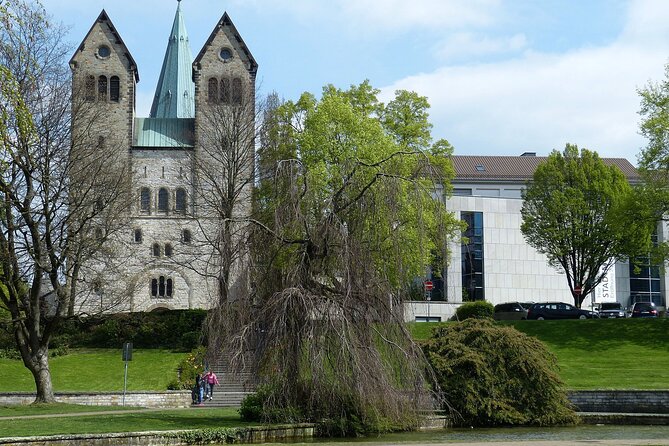
Review · RHINE RIVER
e-Scavenger hunt Paderborn: Explore the city at your own pace
Paderborn rewards a curious walk. This phone-based scavenger hunt takes you through the city at your own pace, linking major sights with small challenges and local details. I like the freedom to pause for a drink in the central square, and I like the private format, which lets your group of up to six set its own rhythm. The main drawback is that you must bring your own smartphone and data, and navigation may take some getting used to.
The route covers a lot in two to four hours, from half-timbered carvings and old churches to the modern shopping street and the Pader River. The information is kept fairly short, which makes it easy to read while walking. Still, one practical tip matters: have Google Maps ready as a backup, since the game’s own navigation may not feel perfectly clear to everyone.
Key points to know before you go
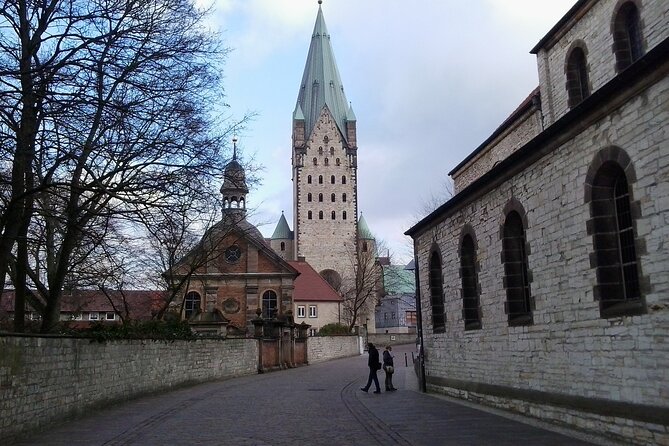
- A private walk for up to six people: Your group explores together without a guide or other participants.
- A strong mix of sights: The route includes Paderborn Cathedral, Abdinghof Monastery, the Bartholomäus Chapel, the town hall, fountains, statues, shops, and the Pader River.
- A flexible two to four-hour pace: You can stop for a drink, rest in the square, or spend extra time inside the historic areas.
- A useful low-cost option: At $36.69 per group, the price can work well for families or friends sharing one booking.
- A phone is essential: The activity includes the online game and city walk, but not the smartphone or mobile data.
- Simple information, not a lecture: The route gives you enough context to notice what you are seeing without burying you in long blocks of text.
A self-guided way to meet Paderborn
This experience combines a city walk with an online scavenger hunt. You use your phone to move from one stop to the next, follow prompts, and learn about the sights along the way. Since it is a private activity, you do not need to match the pace of a guide or wait for a larger group.
That flexibility is the main appeal. You can begin at the listed meeting point on Liboriberg, pause when a church is open, stop for coffee, or take longer at a square that catches your eye. The activity is available every day around the clock during the stated operating period, from November 2, 2022 through March 22, 2027.
The suggested duration is two to four hours. That is a useful range rather than a strict schedule. If you read quickly and keep moving, you may finish near the shorter end. If you stop for refreshments, study the carvings, and take breaks, allow closer to four hours.
I especially like the balance between freedom and structure. You are not simply given a list of places and left to work out the route. The game gives the walk a purpose, while the self-guided format keeps the day relaxed.
More Scavenger Hunts in Germany
- Hamburg: Scavenger Hunt Self-Guided Tour for Children
★ 4.5 · 319 reviews - Dresden: Old Town Self-Guided Scavenger Hunt Tour
★ 4.5 · 151 reviews - Berlin: Self-Guided Family and School Class Scavenger Hunt
★ 4.6 · 128 reviews
Starting at Liboriberg and finding your bearings

The starting point is Parkplatz Liboriberg, at Liboriberg 1004 in Paderborn. The activity ends back at the same meeting point, so you are not left at an unfamiliar part of the city.
Before setting off, charge your phone and make sure your mobile data works. The activity does not include either a smartphone or data service. It is worth opening the route before you start and keeping Google Maps available. The navigation system may not be immediately clear, and a participant found it easier to use the game alongside Google Maps.
That small bit of preparation can make a big difference. You want to spend your attention on Paderborn’s buildings, not on wondering which street corner comes next.
A pause in the central square
One stop brings you to a pleasant square in the middle of the city. It is a natural place to sit, have a drink, and reset before continuing.
This is one of the useful features of the route. A city walk should not feel like a timed examination. The square gives you a chance to slow down, especially if you are walking with children or a mixed-age group.
The square also helps you read the city as a living place rather than a string of monuments. Historic buildings, daily errands, cafés, and passing pedestrians share the same space. The route gives you a reason to stop, but you decide how long to stay.
The carved half-timbered house from about 1560

One of the most memorable stops is a three-storey half-timbered gable house built around 1560. Its fame comes from the carved friezes on the front, with ornamental and figurative scenes cut into the timber.
The lowest of the three carved bands is the most striking. Its scenes tell the story of Adam and Eve’s fall into sin when read in the usual direction. That detail gives you something specific to look for, rather than asking you to admire the house only as an attractive old façade.
I like this stop because it rewards close attention. From a distance, you see a handsome historic building. Up close, you begin to read the carved program and notice how much work went into a private house.
The drawback is simple: exterior details are easy to miss if you rush. Take a few minutes to study the gable from different angles. The short explanation on the phone works best when you are already looking at the carvings.
Same place, a different puzzle:
- Hamburg: Treasure Hunt Game through HafenCity
★ 4.7 · 364 reviews - Treasure Hunt through Hamburg’s Hafencity
★ 5.0 · 234 reviews - Escape Room Adventure in Berlin Solve the Mystery
★ 5.0 · 222 reviews - Escaping and spying on the Berlin Wall Scavenger hunt
★ 4.5 · 128 reviews
Abdinghof Monastery and its 1015 foundation
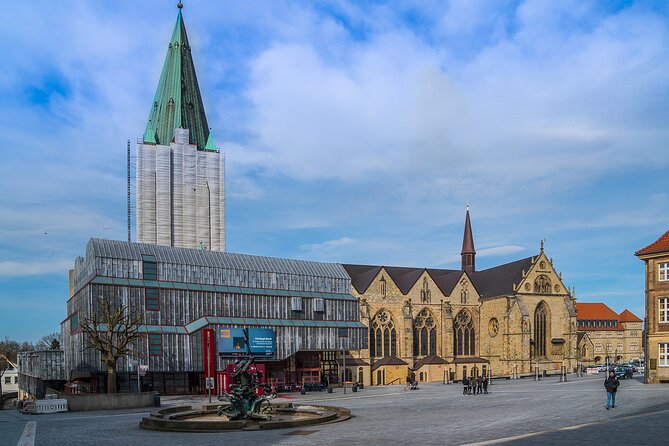
The route continues to Abdinghof Monastery, formerly a Benedictine abbey founded in 1015. The monastery is dedicated to Saints Peter and Paul and remains one of the important historic religious sites on the walk.
A stop here gives the route a stronger sense of time. The half-timbered house shows how older urban buildings could be decorated. Abdinghof points to an earlier religious foundation that helped shape Paderborn’s identity.
You do not need to be an expert in church history to get something from this stop. The key value is seeing how several periods of the city come together within a compact walk. The activity supplies a manageable amount of information, so you can keep moving without reading a long essay on your phone.
The Bartholomäus Chapel and its unusual sound
The Bartholomäus Chapel is described as the oldest known hall church on German soil. Its special acoustics are part of what makes the visit distinctive.
That acoustic detail changes the way you approach the building. You are not looking only at walls, arches, or age. You are also listening. If the chapel is accessible when you arrive, pause quietly and notice how sound behaves inside.
The stop is a good example of the route’s variety. Some locations are best understood through visual details, such as carvings. This one asks you to pay attention with your ears.
Because opening conditions are not provided, you should not assume you will always be able to enter. Even if you can only see the exterior, the chapel remains a useful stop in the walking sequence.
Paderborn Cathedral and three patron saints

Paderborn Cathedral is the major church stop on the route. It is the archiepiscopal church of Paderborn and is dedicated to Mary, Saint Kilian, and Saint Liborius of Le Mans, its principal patron.
The cathedral matters both as a place of worship and as an important German church building from an art-historical point of view. The route gives you the background needed to understand why this is more than a large church in the city center.
I would allow extra time here if the building is open. The self-guided format is particularly useful at a major sight because you can read the explanation, look around, and then continue when you are ready. There is no guide waiting for the group to catch up.
As with the other religious stops, the activity does not promise interior access at a specific time. Treat the route as an outdoor city walk with possible opportunities to enter, not as a timed cathedral tour.
The Markt Church and Paderborn’s Jesuit past
The Markt Church is a Roman Catholic church in central Paderborn. It began as a Jesuit and university church connected with the first University of Westphalia and is dedicated to Saint Francis Xavier.
That university connection gives the church a different character from the cathedral and former Benedictine abbey. The route lets you compare several religious institutions that served different roles: cathedral, monastery, chapel, and Jesuit university church.
The information supplied for this stop appears in more than one form, but the useful point is consistent: this is a central Catholic church with Jesuit and academic roots. If you enjoy noticing how cities organize their religious and educational life, this stop adds welcome context.
Modern shopping beside older Paderborn
Not every stop is an old church or historic façade. The route also takes you along a modern shopping street described as the city’s place for its nicest and most fashionable shops.
This change of scenery keeps the walk from becoming a procession of monuments. You see how Paderborn functions today, with retail streets set among its older central buildings.
The stop may appeal most to people who want a break from formal sightseeing. You can browse, window-shop, or simply use the street as a link between the historic center and the next landmark. It also gives you a chance to compare the city’s present-day style with its older architecture.
Neptune Fountain and Friedrich von Spee
In the middle of the market square is the Neptune Fountain, made by Paderborn artist Josef Rikus between 1977 and 1979. Its date and local authorship make it a modern counterpoint to the older buildings around it.
The fountain is not just a decorative pause. It shows that the city’s public art includes recent work as well as medieval and Renaissance structures. The route’s short format helps you notice this kind of contrast without making it feel like a separate museum visit.
Nearby, you encounter a bronze statue of Friedrich von Spee reading a book. The image is an easy one to recognize, and the book gives the figure a clear visual identity.
Together, the fountain and statue make a pleasant section of the walk. You get public art, a market-square setting, and a chance to rest while still taking in something connected to the city.
The three-gabled town hall
Paderborn’s town hall is a fine example of Weser Renaissance architecture. Its three gables give the building an immediately recognizable outline, while the upper floor, with its many windows, shows the style particularly well.
This is the kind of stop where a little context improves the view. Without the architectural label, you might simply see an ornate historic town hall. With it, you can pay attention to the gables and the repeated windows as deliberate features of the building’s design.
I like having the town hall in the route because it broadens the story beyond churches. Civic power, trade, religion, education, and everyday shopping all appear within the same walk.
Following the small Pader River
The final part of the route follows the small river at the headwaters of the Pader. Paderborn has more than 150,000 inhabitants, yet the route ends with a quieter look at the water that gives the city its name.
This is a fitting change of pace after the central squares, churches, statues, and shopping street. Walking beside the Pader lets you see the city’s geography rather than only its buildings.
The river section also helps explain why Paderborn developed where it did. The route connects the city’s name and setting to a real physical feature, giving the walk a clear sense of place.
What $36.69 buys your group
The price is $36.69 per group of up to six people. That matters because the cost is not charged per person. A full group would pay roughly $6.12 each, before any currency or booking fees that may apply.
For two people, the per-person cost is higher, but you still get a private activity with no guide gratuity or group scheduling to manage. For a family or group of friends, the price is easier to justify because everyone can share one booking.
The value depends on what you want. This is not a guided tour with a person answering questions at every stop. It is a structured phone walk that gives you basic context, challenges, and a route through the center. If you enjoy setting your own pace, the price is fair. If you want detailed storytelling or personal recommendations from a local guide, you may find the format too light.
The activity has a 4.8 rating from four submitted reviews, and the most praised point is its clear, restrained amount of information. One participant appreciated learning about Paderborn without being overloaded. That is useful guidance for anyone who prefers short explanations while walking.
Who will enjoy this format most
I would recommend this experience to families, couples, and friends who want a private city activity without committing to a fixed guided schedule. It also suits independent visitors who like a bit of structure but do not want to follow a guide’s flag through the streets.
It can work well for people who prefer to read rather than listen. The activity is offered in English, and it is user-friendly for people with hearing impairments. Service animals are allowed, and the route is near public transportation.
You should think twice if your phone battery is unreliable, your data plan is limited, or you strongly dislike navigation apps. The activity depends on your device, and the route may be easier when paired with Google Maps.
Most people can participate, but the supplied information does not specify step-free access, restroom locations, or the exact walking distance. If those details matter to you, confirm them before booking.
Cancellation and practical planning
Free cancellation is available if you cancel at least 24 hours before the local start time. Cancellations within 24 hours are not refunded, and changes inside that window are not accepted.
Since the walk is available every day from midnight to 11:59 p.m., you have wide control over timing. In practical terms, daytime is likely to make the churches, shops, and public spaces easier to appreciate, but the activity itself does not impose a narrow start time.
Book only when you know your group can bring a charged smartphone and mobile data. Those two items are not included.
Should you book the Paderborn scavenger hunt?
Book it if you want an affordable, private way to see Paderborn’s main central sights while keeping control of the pace. The route has a good mix: a carved house from about 1560, a monastery founded in 1015, unusual church acoustics, the cathedral, a Jesuit university church, modern shops, public art, the Weser Renaissance town hall, and the Pader River.
Skip it if you want a guide-led tour filled with long historical stories or detailed answers on the spot. The information is intentionally brief, and navigation may require backup help from Google Maps.
For a group of up to six, the price is the strongest reason to book. Prepare your phone, allow two to four hours, and treat the game as a relaxed framework rather than a race. That approach gives you the best chance to enjoy both the landmarks and the ordinary city life between them.
FAQ
Where does the Paderborn scavenger hunt start?
It starts at Parkplatz Liboriberg, Liboriberg 1004, 33098 Paderborn, Germany.
Where does the activity end?
The activity ends back at the meeting point at Liboriberg.
How long does the experience take?
The estimated duration is two to four hours.
How many people can join one booking?
One private group of up to six people can participate.
What is included?
The booking includes an online game and city walk to use on your phone.
Do I need to bring a smartphone?
Yes. Smartphone use is not included, so you must provide your own device.
Is mobile data included?
No. Mobile data is not included, so you should arrange your own data connection.
Is the experience offered in English?
Yes. The activity is offered in English.
Can I cancel for a full refund?
Yes, if you cancel at least 24 hours before the experience start time. Cancellations within 24 hours are not refunded.
Just added around Germany
- Stuttgart Scavenger Hunt and Highlights Self Guided Audio Tour★ 5.0 · 2 reviews
- Stuttgart Self Guided Sherlock Holmes Murder Mystery Game★ 5.0 · 4 reviews
- Private: Outdoor Escape Game Schluchsee: The Lost Village★ 4.5 · 11 reviews
- Rothenburg Scavenger Hunt and Sights Self-Guided Tour★ 4.5 · 11 reviews
- Schwerin Self Guided Sherlock Holmes Murder Mystery Game★ 3.0 · 3 reviews
- Private scavenger hunt around the Ruhrfestspielhaus Recklinghausen★ 4.5 · 3 reviews
- Private scavenger hunt around Broich Castle in Mülheim an der Ruhr★ 5.0 · 5 reviews
- Bielefeld Scavenger Hunt and Private Sights Self-Guided Tour★ 4.0 · 5 reviews
Scavenger Hunts, compared.


Amazing Cozumel Race: Small-Group Tour and Scavenger Hunt
Read our review →
An Epic Scavenger Hunt: New York City Central Park Adventure
Read our review →

Escaping and spying on the Berlin Wall Scavenger hunt
Read our review →
Browse the lists this game appears in