
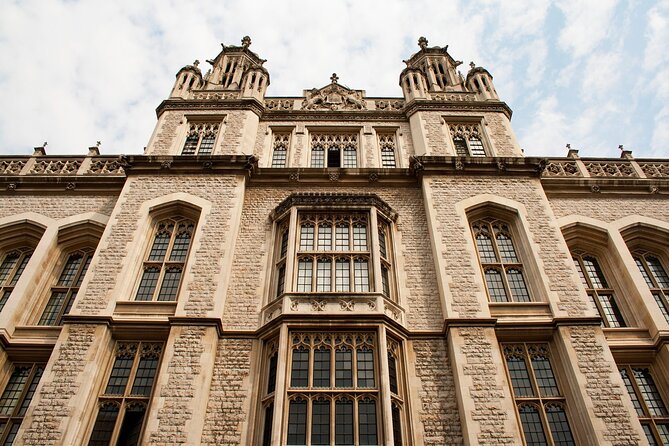
Review · LONDON
London Charles Dickens Puzzle Questo and Self-Guided Tour
Dickens left clues all over London. This self-guided Questo game follows his world from the Charles Dickens Museum to Fleet Street, using puzzles to connect literary landmarks, old pubs, theatres, churches, and historic streets. I like the freedom to start anytime and the low price, just $8.33 per person. I also like that you can pause for a drink, a meal, or a closer look at a building without holding up a group.
The main drawback is simple: there is no human guide. You must use your phone, read the clues, and solve each challenge yourself. That suits independent explorers, but it will not replace a lively guide who can answer questions or add stories on the spot.
Key things to know
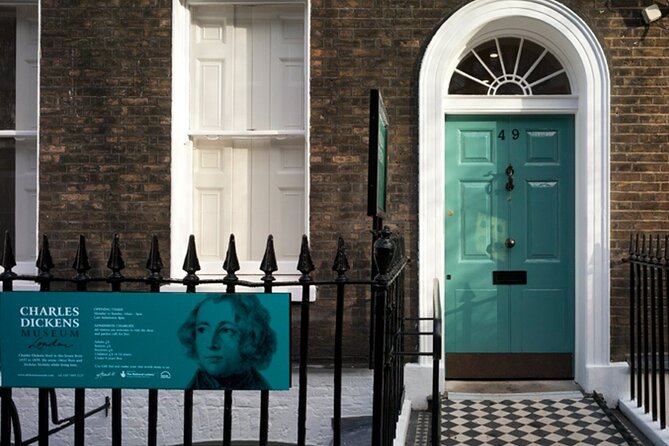
- Begin at 47 Doughty Street, home of the Charles Dickens Museum and the natural starting point for the story.
- Follow a literary route through central London, ending at St Dunstan-in-the-West on Fleet Street.
- Solve location-based clues to move from one stop to the next.
- Play at your own pace, with breaks whenever you like and offline access after setup.
- Expect a private experience, since only your own group takes part.
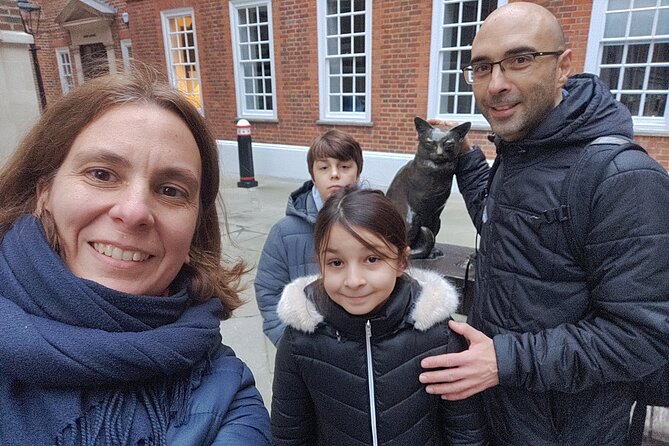
- Look for the Man in Black, a clue that adds a playful thread to the walk.
What kind of London experience is this?
This is part walking tour, part city puzzle, and part Dickens primer. You are not led from place to place by a person. Instead, Questo gives you challenges connected to the streets and buildings around you.
At each stop, you look for an answer that lets you advance. The clues are designed to make you study your surroundings rather than simply march past them. That changes the feel of the route. A doorway, sign, statue, or bit of architectural detail becomes part of the game.
The route is built around Charles Dickens, but it also reaches into London’s wider literary and civic story. You will encounter Samuel Johnson, old theatre sites, medieval church traditions, a former wool staple, a university library, and some of the city’s best-known historic pubs.
The advertised duration is about one hour. That is a useful target if you want a short activity between other plans, though the flexible format lets you stop longer at any location. One especially appealing feature is the ability to pause and resume later. If you find a pub worth entering or want to spend more time near the Dickens Museum, the game does not force you to rush.
More Self-Guided App Games in London
- London’s Crown Secret: Self-Guided Royal Puzzle Quest
★ 4.5 · 8 reviews - London (Covent Garden) Scavenger Hunt and Sights Self-Guided Tour
★ 5.0 · 7 reviews - London Scavenger Hunt and Highlights Self-Guided Tour
★ 4.0 · 4 reviews
Starting at the Charles Dickens Museum on Doughty Street
The tour begins at 47 Doughty Street, close to the Charles Dickens Museum at number 48. This Georgian terraced house was Dickens’s home from March 1837 to December 1839, a key period shortly after his marriage.
The address gives the tour a strong opening. You are not starting with a vague Dickens reference. You are beginning beside a real London home tied directly to the author’s life and work.
The first challenge asks you to look around and find the answer needed to continue. That means the opening is active from the first minute. You will need to pay attention to the building and its setting instead of treating the museum as a quick photo stop.
The museum itself is an author’s house museum. The supplied tour details do not include admission to the interior, so do not assume the puzzle price covers entry. If you want to visit inside, check the museum’s separate opening information and ticket arrangements.
For a short tour, this first stop does important work. It introduces Dickens as a person who lived, worked, and raised a family in London, not just as a name attached to famous novels.
Vine Street and the changing city around Piccadilly
The next location is Vine Street, a street laid out around 1686. Historical mapping shows it once ran from Piccadilly northeast toward Warwick Street, with a brewery and carpenter’s yard among its main properties in the early eighteenth century.
This stop broadens the story beyond Dickens. You are looking at the kind of ordinary commercial setting that helped form London: trades, workshops, breweries, and busy streets rather than grand monuments alone.
The puzzle format works well here because streets change quickly. Modern London can hide earlier uses unless you stop and read the clues carefully. The challenge encourages you to connect the present street with the working city that came before it.
Do not expect a large museum display at this point. The value comes from the setting and the historical prompt. If you prefer major sights with clear signs and long explanations, this may feel light. If you like noticing small details, it gives the route a welcome change of pace.
A Dickens pub connection and Bill Sykes
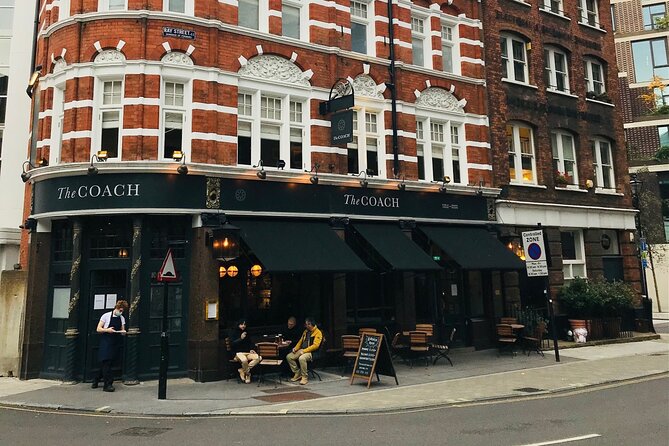
One of the most entertaining stops is the stylish inn dating from 1759. Its Dickens connection comes from 1838, when he changed its name to the Three Cripples and used it as Bill Sykes’s preferred watering hole in Oliver Twist.
This is where the literary theme becomes more vivid. Dickens took a real London setting and reshaped it for fiction, giving the pub a role in the grim world of Bill Sykes.
The challenge asks you to inspect the location for the answer. You may also want to pause here for a drink, subject to the establishment’s own opening hours and service. One useful feature of this game is that a pause does not spoil the experience. You can take a break and continue when you are ready.
A pub stop also explains why the flexible format matters. A traditional one-hour walking tour keeps moving. This one lets you decide if a Dickens-linked inn deserves five minutes, half an hour, or only a quick look from outside.
More Self-Guided App Games in the UK
- Romantic Notting Hill: Self-Guided Love Story Puzzle Walk
★ 4.5 · 3 reviews - Secrets of Bermondsey: Self-Guided Urban Puzzle Walk
★ 5.0 · 2 reviews - London Self-Guided Sherlock Holmes Murder Mystery Game
★ 4.0 · 2 reviews - London Shoreditch Scavenger Hunt and Sights Self-Guided Tour
★ 5.0 · 2 reviews
Staple Inn and London’s working past
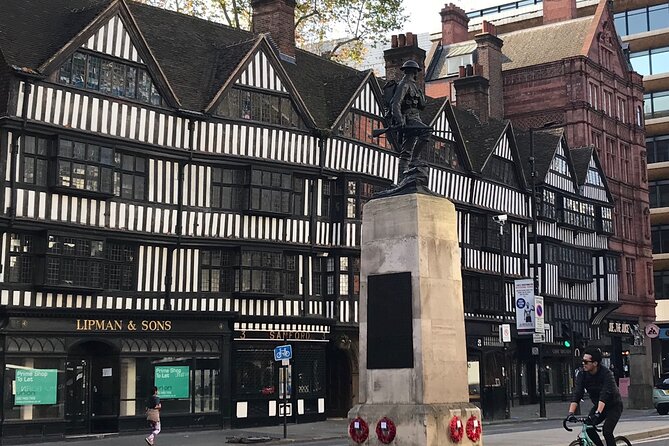
Staple Inn dates from 1585. It began as a wool staple, where wool was weighed and taxed, and it survived the Great Fire of London in 1666. The building later suffered heavy damage from a Luftwaffe bomb in 1944 before being restored.
This is one of the route’s strongest architectural stops. Its story crosses several periods of London history, from the wool trade to wartime destruction and repair.
The puzzle gives you a reason to examine the building rather than simply admire its age. You will need to look around for the clue, so take your time with the visible details. The surrounding area is also a reminder that central London often places old structures beside modern offices and traffic.
Staple Inn is not directly a Dickens home or writing room, but it fits the wider theme of the city that Dickens knew. London’s streets carried commerce, law, publishing, theatre, and poverty side by side. This stop adds that broader context.
Lincoln’s Inn Fields and a vanished theatre
Lincoln’s Inn Fields was home to a theatre from 1661 until 1848. The building was demolished, but its origins reach back to Lisle’s Tennis Court, converted into the Duke’s Theatre in 1695.
Here, you are following a site that is no longer present in its original form. That can be harder to grasp than a preserved building, but it also makes the puzzle useful. The clue points you toward the past and asks you to imagine a theatre where the current scene may give little away.
For anyone interested in London’s stage history, this is a worthwhile addition. Dickens wrote for a city shaped by performance, public entertainment, and crowded commercial venues. A vanished theatre helps explain the cultural setting around his work.
The drawback is that there may be less physical evidence to inspect than at Staple Inn or the Dickens Museum. You will get more from this stop if you enjoy historical reconstruction and do not need every story to come with a standing building.
The Maughan Library and a grand Victorian building
The Maughan Library occupies a Grade II* listed building designed by Sir James Pennethorne. The original structure was built in 1851, with later extensions between 1868 and 1900. After a £35 million renovation by Gaunt Francis Architects, it became the largest new university library in the United Kingdom since World War II.
This is an impressive architectural pause in the route, even though its connection to Dickens is indirect. The building reflects the nineteenth-century city’s confidence in education, public institutions, and grand civic design.
You will again need to look around for the next answer. The puzzle turns the building into part of the game rather than a passive backdrop.
Because it is a working library, treat the area with care. The provided details do not promise interior access, so plan to appreciate the building from the permitted public areas and follow any signs on site.
I like this stop because it keeps the route from becoming a string of Dickens-only references. It shows the London of institutions and learning, the same city in which literary culture flourished.
Dr Johnson’s House and the literary neighborhood
Dr Johnson’s House was probably first built for a City merchant. Samuel Johnson rented it from 1748 to 1759, making this one of the route’s clearest links to another major English literary figure.
The address brings a different author into the story. Dickens was not working in isolation. London had long attracted writers, editors, scholars, and people who made their living from words.
This stop suits readers who enjoy literary connections beyond the named theme. The small house setting also balances the larger library and institutional buildings earlier in the walk.
As with the other locations, the game asks you to find an answer on site. That turns the visit into a focused observation exercise. You are not simply told that Johnson lived here. You must engage with the place before moving on.
Ye Olde Cheshire Cheese after the Great Fire
Ye Olde Cheshire Cheese was first built in the 1530s, but the original pub was destroyed in the Great Fire of London in 1666. The current building dates from 1667 and was among the first London structures rebuilt after the fire.
This stop carries several layers of atmosphere: an old drinking place, the city’s great disaster, and the rapid rebuilding that followed. It also fits the Dickens theme because pubs and public houses were central to the social life he observed and wrote about.
You may want to allow extra time here, especially if you enjoy historic interiors and traditional pub settings. The game itself remains flexible, so you can pause before continuing.
The supplied experience does not include food or drink, so budget for those separately. Still, this is exactly the kind of location where the low-cost puzzle can lead you into a more personal London experience. The game points you toward a place, then lets you decide how long to stay.
The basilica-style church and a different London story
Another stop is a church consecrated in 1863 as the Church of St Peter of all Nations. At the time, it was the only basilica-style church in the United Kingdom. Its organ was built in 1886 by the Belgian maker Anneesen.
The church also has a wartime connection. During World War II, when Italian immigrants were interned, Irish Pallottines used the building.
This is a quieter and more unusual chapter in the route. It moves away from famous writers and pubs into the story of London’s immigrant communities, worship, music, and wartime disruption.
The location rewards respectful observation. Church access can vary, and the tour information does not guarantee entry, so be prepared to solve the clue from the available public setting.
The Royal College of Surgeons and professional London
The Royal College of Surgeons traces its earliest origins to the 1540s, when the Company of Barbers and the Fellowship of Surgeons joined to form the Company of Barber-Surgeons. By the eighteenth century, medicine had become an academic discipline, and surgeons sought greater recognition for their expertise.
This stop adds a scientific and professional strand to the walk. Dickens’s London was not only about authors and characters. It was also a city where trades became professions, institutions gained status, and specialist knowledge grew.
The building and its history may appeal most to anyone interested in medicine or the development of professional life. For others, it provides a useful change after several literary and religious locations.
Once again, the challenge is the point. You need to observe, interpret, and find the answer rather than passively listen to a lecture.
St Dunstan-in-the-West and the final clue
The route ends at 145 Fleet Street, at St Dunstan-in-the-West. The church shares its building with the Romanian Orthodox community, including St George Church.
The Romanian Orthodox chapel sits to the left of the main altar and is separated by an iconostasis formerly from Antim Monastery in Bucharest. It was dedicated in 1966.
This is a fitting final stop because it brings together old London, international connections, and changing religious life. Fleet Street is also a natural place to end a literary-themed walk, given its long association with publishing and newspapers, though the supplied tour details focus on the church itself.
The finish gives you a final clue and a clear endpoint rather than leaving you somewhere vague. From there, you can decide what to do next in central London.
Price, pacing, and what you really receive
At $8.33 per person, this is priced as a light activity rather than a full guided tour. That makes it good value if you want a structured hour of exploration without paying for a private guide.
The low price comes with limits. You do not receive a physical guide, live commentary, or a person to explain difficult clues. You are paying for the digital game, route, and story prompts.
I see the strongest value in the flexibility. You can start at any hour, take breaks, and resume later. The game is available around the clock, every day, and it can be played offline, so you do not need a constant internet connection while walking.
It is also a private activity. Only your group takes part, with no strangers added to your game. That is useful for couples, families, and small groups who want to set their own pace.
Group discounts are available, though the supplied details do not give the discount amount. The tour is also offered in English.
Practical advice before you start
Use the starting point carefully. The listed meeting point is 47 Doughty Street, while the Charles Dickens Museum is at 48 Doughty Street. That is close, but you should still check the address before beginning.
Allow more than the one-hour estimate if you want to stop at the pubs, study the buildings, or visit any place with separate opening arrangements. The game may take about an hour when played directly, but the whole experience can become a longer outing.
Wear shoes suitable for city walking, though the tour details do not state a precise distance. Keep your phone charged and download or prepare the game before setting off if possible. Offline play is supported, which helps if your connection drops in the city.
The clues are not designed to be impossibly hard. One happy player described them as neither too easy nor too difficult and particularly enjoyed searching for the Man in Black. That gives you a useful sense of the tone: playful, observant, and manageable without being automatic.
Free cancellation is available up to 24 hours before the start time. Cancellations within 24 hours are not refunded, and changes made inside that period are not accepted.
Who should choose this Dickens puzzle?
I would recommend it to you if you enjoy solving clues, noticing architectural details, and building your own route through London. It also suits a small private group that wants control over stops and timing.
Families with older children may like the game element, although the supplied information does not specify a minimum age. Readers interested in Dickens, Samuel Johnson, historic pubs, churches, theatre history, or old City institutions will find plenty of variety.
I would hesitate if you want a polished lecture, detailed literary analysis, or immediate answers to every question. A live guide could add more context and handle the walking logistics for you.
Should you book it?
Book this experience if you want an inexpensive, flexible way to connect Dickens with the streets around Holborn, the City, and Fleet Street. The best parts are the Doughty Street opening, the Bill Sykes pub connection, the historic buildings, and the freedom to pause whenever you please.
Skip it if you strongly prefer guided commentary or do not enjoy using your phone while sightseeing. At $8.33, the risk is small, and the private format gives you room to play at your own speed. Just remember what you are buying: a clever self-guided city game, not a traditional tour with a person leading the way.
FAQ
How much does the London Charles Dickens Puzzle Questo tour cost?
The listed price is $8.33 per person. Group discounts are available, but the discount amount is not specified.
How long does the experience take?
The estimated duration is about one hour. You can take breaks and resume later, so your total outing may be longer.
Where does the tour start?
The listed starting point is 47 Doughty Street, London WC1N 2LW, close to the Charles Dickens Museum at 48 Doughty Street.
Where does the tour finish?
The tour ends at 145 Fleet Street, London EC4A 2BU, at St Dunstan-in-the-West.
Is a physical tour guide included?
No. This is a self-guided experience and does not include a physical guide.
Can I start at any time?
Yes. The experience is available 24 hours a day, seven days a week, and you can start at any hour.
Can I pause the game?
Yes. You can take a break at any time and resume later.
Do I need an internet connection while playing?
No. The game supports offline play, so you do not need an internet connection during the activity.
Is this a private tour?
Yes. Only your group participates, with no other groups added to your activity.
Is cancellation free?
You can cancel for a full refund up to 24 hours before the scheduled start time. Cancellations made less than 24 hours before the start time are not refunded.
Just added around London
- Zombie Scavengers Game – Southend-on-Sea, UK★ 4.5 · 2 reviews
- Undercover Agent Escape Game – High-Tech Spy Thriller★ 5.0 · 2 reviews
- e-Scavenger Hunt London: Explore the City at Your Own Pace★ 4.5 · 3 reviews
- Unique Survival Scavenger Hunt in Luton by Zombie Scavengers★ 3.0 · 2 reviews
- Secrets of Bermondsey: Self-Guided Urban Puzzle Walk★ 5.0 · 2 reviews
- Operation City Quest Scavenger Hunt – Southend-on-Sea, UK★ 3.5 · 2 reviews
- Private Prison Van Escape Game – London Immersive Experience★ 4.0 · 15 reviews
- London Self-Guided Sherlock Holmes Murder Mystery Game★ 4.0 · 2 reviews
Self-Guided App Games, compared.








Browse the lists this game appears in