
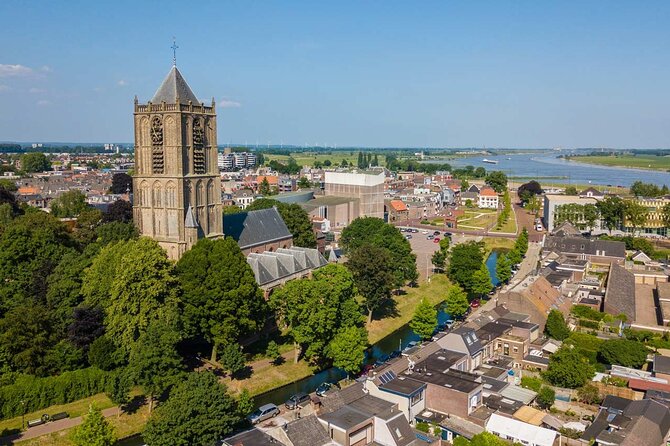
Review · NETHERLANDS
e-Scavenger hunt Tiel: Explore the city at your own pace
Tiel becomes a puzzle, not a postcard stop. This self-guided city game mixes GPS clues, local facts, and search tasks, so you explore at your own pace instead of following a guide with a flag. I like the flexible start time and the strong value for groups of up to six. The main drawback is that you need your own smartphone and mobile data, and some stops may be less rewarding if you expect major sights at every turn.
You begin and end at Kalverbos 1-3, near the center, and the route takes about two to four hours. I also like that the questions are designed to be approachable without being dull. The challenge can be relaxed, but finding the next location by counting down the meters adds a little friendly tension.
Key points before you book

- A group price that rewards company: The $35.89 cost covers up to six people, making it especially good value for families, work groups, and friends.
- A flexible city game: Start, pause, or stop when it suits you. The activity is available from noon to midnight every day according to the stated opening hours.
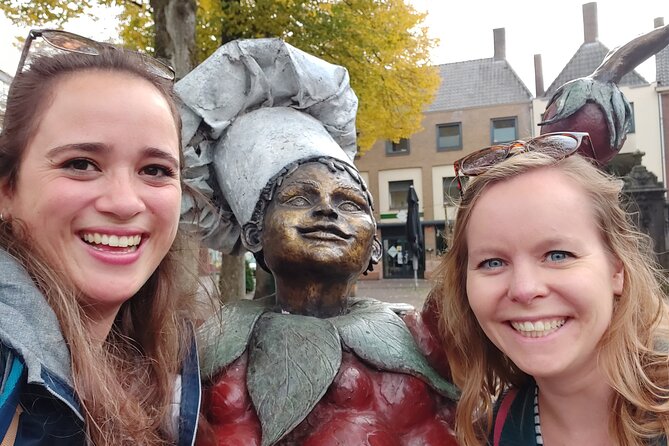
- Tiel through local symbols: Flipje, the famous fruit character, connects the town to its jam-making past and the wider Betuwe fruit region.
- Seven varied stops: Expect a museum about jam production, a theater, a 24-hour casino, churches, a medieval house, a chapel, and old gardens.
- A light challenge rather than a history lecture: You answer questions and complete search assignments on your phone, with GPS helping you move between locations.
- Private and family-friendly: Only your group takes part, and most people can participate, including people traveling with service animals.
How the Tiel city game works
After booking, you receive instructions for signing in to the free city game app. You use your own phone to read questions, follow GPS guidance, answer location-based prompts, and complete search assignments.
This format gives you control. You can begin when you want, pause for a drink, stop for lunch, or return later if two to four hours feels too long in one stretch. That freedom matters in Tiel, where the appeal is less about racing from one grand sight to another and more about noticing small details in the center.
The game is built for a team of up to six people. That is a practical limit. Six people can discuss an answer without becoming a crowd, while larger parties can split into teams if they want a more competitive afternoon. The activity is private, so you are not sharing the experience with strangers.
The questions are not meant to replace a museum guide or a detailed walking tour. They give you a reason to look closely at buildings and public spaces. One useful feature is the distance countdown used to help locate the next point. It is simple, but it makes navigation part of the game instead of just a chore.
You should arrive with a charged smartphone and enough mobile data. The phone and data are not included. Since the route uses an app and GPS, this is not a good choice if you want to leave your phone in your pocket for the whole afternoon.
More Scavenger Hunts in the Netherlands
- e-Scavenger hunt Maastricht: Explore the city at your own pace
★ 4.5 · 110 reviews - e-Scavenger hunt Middelburg: Explore the city at your own pace
★ 4.5 · 55 reviews - e-Scavenger hunt Den Bosch: Explore the city at your own pace
★ 4.5 · 37 reviews
Starting at Kalverbos and finding your bearings
The meeting point is Kalverbos 1-3, 4001 AK Tiel. The activity ends back at the same meeting point, giving you a clear beginning and finish rather than leaving you on the far side of town.
The listed hours run from 12:00 AM to 11:59 PM, Monday through Sunday, during the published operating period. In practical terms, you have broad freedom over when to start, but the museum stop deserves special attention. One note about Tiel says the museum opens around noon, so check the museum’s own hours if seeing its interior matters to you. The city game itself may be available outside those hours, but a museum door may not be.
I would allow the full two to four hours if you want time for photos, a café stop, or a slower look at the churches and gardens. A faster group may finish sooner. The route is not described as a guided march, so your pace will shape the day.
Flipje and Tiel’s jam-making story
One of the most distinctive stops is a museum devoted to the old jam factory and the fruit industry of the Betuwe. Between 1885 and 1993, millions of jars of jam and fruit juices were produced in the region. The display includes a large model of the factory and old advertisements featuring Flipje, the recognizable fruit figure linked with Tiel.
This gives the game a useful local anchor. You are not just collecting answers about anonymous streets. You are learning why Tiel is known as a fruit town and how one factory helped shape its public identity for more than a century.
Flipje is also a good example of the kind of detail that makes a small city walk worthwhile. A major European capital can offer famous monuments at every turn. Tiel offers something more specific: a local character, a food industry, and a regional identity tied to the Betuwe.
The main limitation is timing. If the museum is only open from around midday, an early start may mean seeing the building from outside while answering the app’s prompt. If the museum is important to you, plan the game around its opening time rather than assuming every stop will be accessible all day.
Theater, casino, and the modern side of town
The route also visits a theater with a seasonal cultural program of roughly 180 performances. That stop adds a look at Tiel as a working cultural center, not only a town of old churches and medieval buildings.
You may not be able to see a performance during the game, but the theater still helps explain the town’s present-day social life. Its inclusion also breaks up the older architectural stops. A good city game needs that variety, and this route does not keep you looking only at stone walls and church towers.
Another stop is Gran Casino Tiel, located at the Van der Valk hotel. It is noted as the first casino in the Netherlands to open 24 hours a day, seven days a week. That fact gives the route a modern talking point and a little contrast with the medieval buildings elsewhere in the center.
Do not treat the casino as a required entertainment stop unless you specifically want that. Its value here is mainly as a landmark and a piece of local trivia. The route lets you see how different parts of Tiel fit together, from fruit production and religious buildings to hotels, theater, and round-the-clock leisure.
Same place, a different puzzle:
- Amsterdam Treasure Hunt: The Mystery of a Secret Sender
★ 5.0 · 149 reviews - Amsterdam: Treasure Hunt Walking Tour “A Secret Sender”
★ 4.7 · 71 reviews - Utrecht Old Town: Medieval Monster Hunt & Walking Tour
★ 4.0 · 62 reviews - Discover Utrecht with a self-guided Outside Escape city game tour
★ 4.5 · 51 reviews
The Sint-Maartenskerk and Tiel’s oldest skyline
At the edge of the center, the Sint-Maartenskerk rises above the surrounding buildings. Its tower has marked Tiel’s skyline for centuries, and the church is named for Saint Martin, a Hungarian nobleman.
This should be one of the more visually useful stops. A tower is easy to spot, which helps you orient yourself as you move through the streets. It also gives the game a strong sense of place. You are not simply walking between app coordinates; you are using one of Tiel’s oldest landmarks to understand the shape of the center.
The description does not promise an interior visit, a tower climb, or a guided explanation inside the church. Keep expectations at that level. The game is built around questions and observations, not admission-based sightseeing.
Still, this is the kind of stop that works well for a self-guided activity. You can pause, look up at the tower, consider the church’s long presence in the city, and then move on when your group is ready.
A medieval house on Kleibergsestraat

On the corner of Kleibergsestraat, the Gothic House offers one of the route’s best architectural details. It retains much of its late medieval Lower Rhine facade, including a stepped gable and gable niches.
For you, the important point is to look up. A facade like this can be easy to pass if you are focused only on the next GPS marker. The app’s question should encourage you to study the shape, decoration, and position of the building rather than treating it as a quick waypoint.
This stop also shows why the city game can work better than a standard list of sights. You are given a task, so your group has a reason to inspect the building. Children may enjoy the search element, while adults get a short introduction to a regional architectural style.
The building is viewed from the street as part of the city walk. There is no information about interior access, so plan on appreciating it from outside.
Saint Caecilia Chapel and the traces of a vanished monastery
The medieval Saint Caecilia chapel is a national monument. It once belonged to a monastery that no longer survives, leaving the chapel as a remaining piece of that former religious complex.
This is a quieter stop than the main church. Its value comes from what is missing as much as what remains. The chapel gives you a glimpse of an institution that shaped part of the town but has disappeared from the modern view.
That kind of stop rewards a slower group. Read the prompt carefully, examine the exterior, and take a moment to picture how different the area would have looked when the monastery was still active. The game cannot recreate the lost buildings, but it can make you notice the surviving one.
Again, do not assume the chapel is open for an interior visit. The supplied details identify it as a monument on the route, not as an attraction with guaranteed admission.
Ambtmanstuin and Hoogenboomtuin
The final pair of notable stops brings you to two gardens with old houses. The houses at Ambtmanstuin and Hoogenboomtuin date from the 16th and 15th centuries. Their present garden designs are from around 1860 and were probably created by K.G. Zocher.
These gardens add a calmer finish to the route. After the museum, churches, public buildings, and urban streets, you get a chance to focus on open space, old homes, and planned garden design.
The wording about the gardens is careful, with the designs probably attributed to K.G. Zocher. You should treat that as an informed attribution rather than an absolute fact. The age of the houses, however, gives the stop a firm historical base.
This is also a good place to slow down if your group has been competing over answers. The activity is supposed to be fun, not a timed exam. A garden stop gives you room to compare answers, take a break, and enjoy the setting before returning to Kalverbos.
What the price means for your group
The price is $35.89 per group of up to six people. At full capacity, that works out to about $5.98 per person, which is strong value for a two to four-hour private activity.
The price becomes less attractive for a solo visitor or a pair. A group of six gets the best deal, while a couple pays the same group rate without sharing the cost with more people. That is the main pricing point to consider.
You are paying for the digital game and route rather than a live guide. That explains both the affordable rate and the limits. You will not have someone on hand to answer a difficult history question, adjust the route in real time, or lead you into buildings.
For families and workplace groups, the format makes financial sense. It gives everyone a shared task and leaves room to buy a drink or meal during the outing. A small group that dislikes fixed schedules may also prefer this to a traditional walking tour.
The best fit, and the less suitable fit
I would recommend this activity if you want an easygoing way to see Tiel while keeping control of the day. It suits families, groups of friends, colleagues, and anyone who likes puzzles more than long historical speeches.
It is also a good choice if Tiel is a place where you already work or live and want to see familiar streets differently. The questions can turn an ordinary route into a small challenge, and the distance countdown gives even well-known streets a new purpose.
The experience is less suitable if you want a highly detailed architectural tour, a live guide, or guaranteed access to every building. It may also disappoint you if you expect a city filled with major headline sights. One piece of direct feedback describes Tiel as quiet and not especially remarkable on its own, but much more enjoyable when approached through the game. That is a fair way to set expectations.
The strongest praise centers on three things: laughter, learning, and a relaxed pace. You can spend time outdoors, take a drink break, and still feel that you have done something structured. The questions are described as neither too easy nor too hard, which is exactly the right balance for a mixed-age group.
Practical details are simple. Confirmation is provided at booking, service animals are allowed, and the activity is near public transportation. It is described as suitable for most people and user-friendly for people with hearing impairment. Free cancellation is available if you cancel at least 24 hours before the local start time. Cancellations or changes inside that window are not refunded or accepted.
Should you book the Tiel e-Scavenger Hunt?
Book it if you have up to six people, enjoy light puzzles, and want a flexible introduction to Tiel’s fruit-town identity, churches, old houses, and gardens. The price is particularly good for a full group, and the private format means you can play without keeping pace with strangers.
I would choose it for a relaxed afternoon rather than as the sole reason for a major trip to Tiel. Pair it with a café stop, check the museum’s opening time, and bring a charged phone with mobile data. If you accept that the town’s pleasures are quiet and specific rather than grand, this city game gives you a lively reason to notice them.
FAQ
How much does the e-scavenger hunt cost?
The price is $35.89 per group, with up to six people included.
How long does the activity take?
The estimated duration is two to four hours.
Where does the activity start?
It starts at Kalverbos 1-3, 4001 AK Tiel, Netherlands.
Where does the activity finish?
The activity ends back at the meeting point at Kalverbos 1-3.
Can I choose when to start?
Yes. The city game can be done at a time you choose, and the listed operating hours are Monday through Sunday from 12:00 AM to 11:59 PM.
Do I need a smartphone?
Yes. You need your own smartphone and mobile data. They are not included.
Is this a private activity?
Yes. Only your group participates.
Is the activity suitable for families?
Yes. It is described as a fun, family-friendly game, and most people can participate.
What is the cancellation policy?
You can cancel for a full refund at least 24 hours before the local start time. Cancellations or changes made less than 24 hours before the start are not refunded or accepted.
Just added around the Netherlands
- Discover Utrecht’s Zocherpark in this Outside Escape game tour!★ 5.0 · 2 reviews
- Utrecht Scavenger Hunt and Highlights Self Guided Audio Tour★ 4.0 · 10 reviews
- e-Scavenger hunt The Hague: Explore the city at your own pace★ 3.5 · 10 reviews
- The Hague Scavenger Hunt and Highlights Self Guided Audio Tour★ 3.5 · 8 reviews
- Delft Self Guided Sherlock Holmes Murder Mystery Game★ 4.5 · 2 reviews
- The Blue’s Clues in Delft Exploration Game and Tour★ 3.5 · 10 reviews
- 90 minutes Self Guided Walking Tour with puzzles in Den Haag★ 4.5 · 7 reviews
- e-Scavenger hunt Schiedam: Explore the city at your own pace★ 4.5 · 4 reviews
Scavenger Hunts, compared.


Amazing Cozumel Race: Small-Group Tour and Scavenger Hunt
Read our review →
An Epic Scavenger Hunt: New York City Central Park Adventure
Read our review →

Escaping and spying on the Berlin Wall Scavenger hunt
Read our review →
Browse the lists this game appears in