
Review · MUNICH
Ghosts of Munich: The Haunted Apprentice Exploration Game
Munich has secrets beneath its polished surface. This self-guided adventure uses the city center as its game board, sending you from Odeonsplatz through Hofgarten, historic churches, Marienplatz, and the New Town Hall while audio stories and puzzles reveal darker tales. I like the very low price and the freedom to start, pause, and continue whenever you wish. I also like that the game works offline, a useful touch if German data charges are a concern.
The main drawback is simple: there is no physical guide. You must follow the clues, use your phone, and keep the group moving on your own. Some stops also have admission charges that are not included, so the final cost can rise if you enter the churches or climb St. Peter’s tower.
Key points at a glance
- About $7.21 per person: A low-cost way to add structure and spooky stories to a Munich walk.
- Eight central stops: The route links Odeonsplatz, Hofgarten, major churches, Marienplatz, and the New Town Hall.
- Works offline: You can avoid expensive phone data charges after accessing the game.
- Flexible timing: Start at any hour, pause for food or coffee, and resume later.
- Private and self-guided: Only your group plays, with no guide or larger tour party.
- Team-friendly puzzles: The game suits families and groups that enjoy observation, cooperation, and light competition.
What this Munich game actually feels like
This is not a traditional ghost tour with a guide leading you through the dark. It is a city walk wrapped in a puzzle game. You receive clues and audio stories in English, then use what you see around you to answer questions and move to the next point.
I like that setup for Munich because the historic center is compact and full of visual details. You can look up at a church facade, inspect a statue, or study a square while also learning why the place matters. The spooky theme gives you a reason to pay attention instead of simply walking from one landmark to the next.
The route takes about one to two hours, though your pace will depend on how much time you spend looking around and whether you enter any buildings. Each stop is estimated at roughly ten minutes, except St. Peter’s Church, where the suggested time is about nineteen minutes. That longer stop reflects the optional tower climb, which involves 299 steps.
The tone appears best suited to families, couples, teenagers, and small groups. One family used it with two teenagers and found that it encouraged teamwork and observation. That is useful advice: this works better when several people discuss clues together than when one person races ahead with the phone.
More Zombie and Horror Games in Germany:
- Apocalypse Zombie 2213 Escape Game in Prague
★ 5.0 · 383 reviews - Shepton Mallet Prison Escape Room – The Cell
★ 5.0 · 187 reviews - Walking Dead Escape Room in Myrtle Beach
★ 4.5 · 142 reviews
Beginning at Odeonsplatz and Hofgarten
The game starts at Odeonsplatz, an impressive square designed in the early 19th century by Leo von Klenze in an Italian-inspired style. The broad space and formal buildings give you a grand opening, but the first story turns sharply darker.
In 1921, an obscure political leader and a small band tried to march into Munich and seize control of Bavaria. Authorities knew what was coming and waited with machine guns at Odeonsplatz. Several people died in the shooting, but the unknown leader escaped. The clue asks you to identify this controversial figure and connect the event to the terrible deaths that followed across Europe.
This is an unsettling piece of political history, and it gives the game more weight than a string of invented ghost stories. You are not simply hunting for a phantom. You are being asked to notice how Munich’s public spaces have been used during moments of danger.
From there, the route moves to Hofgarten, a small formal park created in the 17th century for Elector Maximilian I. It was modeled on an Italian Renaissance garden and was once reserved for dukes, electors, and other high-ranking figures. Today, you can sit among the paths and greenery without needing a noble title.
The clue here depends on looking around carefully. The park is a calmer change from the open square, and it gives you a chance to pause if your group needs a break. I would not rush this stop. The game’s strongest moments come when you combine the story with the setting, and Hofgarten rewards a slower look.
Theatine Church and the Sitting Boar
The next stop is Theatinerkirche St. Kajetan, a Catholic church built in the mid-17th century by Elector Ferdinand Maria and his wife, Henriette Adelaide. They commissioned it to celebrate the birth of a long-awaited heir to the Bavarian throne.
The church is easy to recognize from its yellow exterior, while the inside is white and ornate. That contrast helped make it an important example of German Baroque architecture. The game asks you to find answers connected to the building, but you should also allow time to appreciate the interior if it is open.
Admission is not included here. The supplied information does not give an entrance price or confirm the exact access arrangements, so treat going inside as an optional extra rather than a guaranteed part of the game. You can still experience the exterior and continue along the route if you prefer to keep costs low.
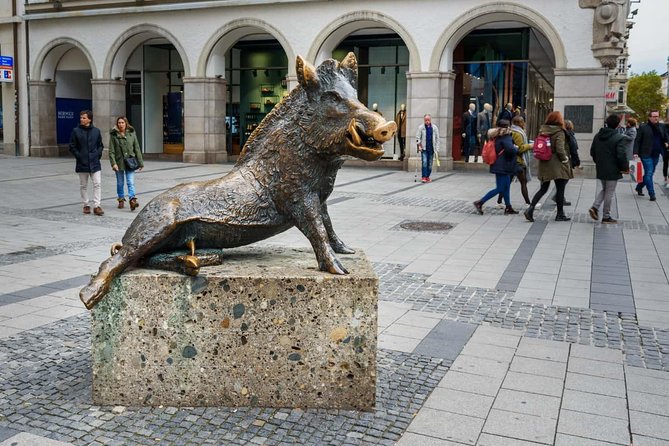
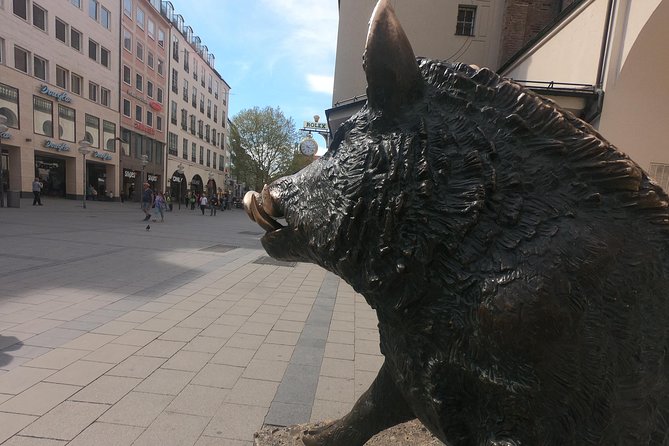
The fourth stop changes mood again. The Sitzender Keiler, or Sitting Boar, is a statue of a pig positioned near the entrance to the Hunting and Fishing Museum. Its odd pose makes it memorable, and the local custom is practical as well as playful: rub the boar’s nose for good luck.
This is one of the easiest stops to enjoy with children or teenagers. It gives the group something physical to do, and the statue’s unusual shape makes the clue easier to remember. You do not need a museum visit to appreciate the boar from outside, and admission to the statue stop itself is free.
Frauenkirche and the Devil’s footprint
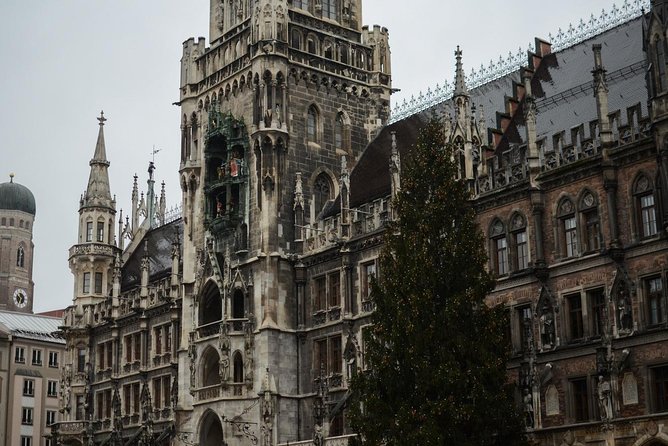
The route then reaches Frauenkirche, or the Cathedral of Our Dear Lady. Its twin towers rise to about 100 meters, making the church one of Munich’s most recognizable landmarks.
Inside, you can expect vaulted ceilings and long stained-glass windows. The game focuses on the Devil’s footprint near the entrance, tied to a legend about the church builder and the Devil. According to the story, the builder wagered that the church would have no windows. When the Devil realized he had been deceived, he left his footprint behind.
The story is classic European church folklore, but the setting makes it effective. You are looking for a physical detail in a major landmark, not searching an empty street for something impossible to see. The clue encourages you to inspect the entrance rather than simply photograph the towers and move on.
Admission to Frauenkirche is not included. As with Theatine Church, you should regard entry as an added option and check the conditions on the day. If you are watching every euro, the game still works as a route through the surrounding city center, but some of the experience’s details are best appreciated from inside.
More City Exploration Games in Germany:
- Frankfurt Old Town & Emperors: City Game & Walking Tour
★ 4.5 · 39 reviews - Nuremberg: Medieval Darkness Exploration Game
★ 4.0 · 18 reviews - City game scavenger hunt Erfurt – independent city tour I discovery tour
★ 4.0 · 9 reviews - City game scavenger hunt Leipzig city center – independent city tour
★ 5.0 · 6 reviews
Marienplatz, where the city gathers

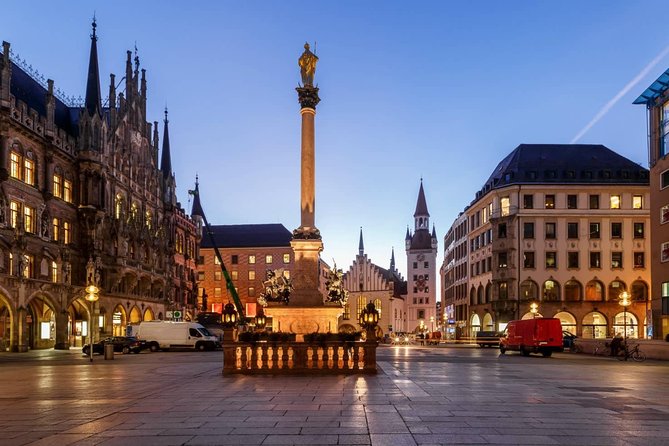
Marienplatz has been Munich’s central square since the city was founded by Henry the Lion in the 12th century. The city’s main streets met here, and public events, including tournaments, took place in the square over the centuries.
Today, this is the liveliest point on the route. Christmas markets, city anniversary events, and FC Bayern celebrations all use the square. The game asks you to look at this crowded public place through a different lens and work out what happened here.
I like this stop because it shows how the experience uses ordinary Munich sightseeing rather than sending you to remote locations. You are already likely to visit Marienplatz, but the puzzle gives you a new reason to study it. The tradeoff is that crowds may make it harder to concentrate, especially during major events or busy shopping hours.
Give yourself room to stop safely and discuss the clue. Since the game is private, your group can take a moment without waiting for a guide. Still, keep an eye on one another and avoid blocking busy walkways while you compare answers.
St. Peter’s Church and 299 steps
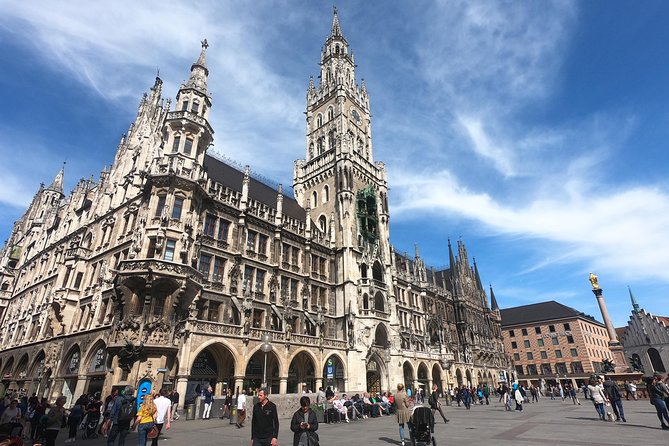
St. Peter’s Church is Munich’s oldest Catholic church, with a history stretching back about 800 years. Fires, wars, and repeated rebuilding have left it with a mixture of Gothic, Baroque, and Rococo features.
This is the longest stop on the route, estimated at nineteen minutes. The major extra attraction is the tower, reached by climbing 299 steps. At the top, you get a bird’s-eye view over central Munich.
The tower climb is not included in the price. The provided details do not state the admission fee, so check locally if you want to go up. You should also consider your group’s energy. The game itself lasts about one to two hours, but the climb can add effort and time.
I would treat the tower as optional rather than essential. If you enjoy city views and do not mind stairs, it may become the highlight of the walk. If your group includes anyone who prefers a gentler outing, you can focus on the church and continue with the puzzle without making the climb.
Finishing at the New Town Hall
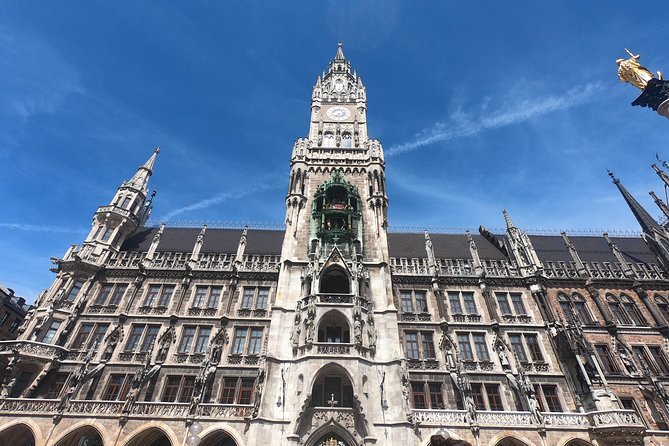
The final stop is Munich’s New Town Hall, or Neues Rathaus, at the end point near Rindermarkt. The building houses the city council and is also famous as the balcony where FC Bayern celebrates championship wins with supporters.
Its Glockenspiel is the main attraction. The performances tell stories, including one about barrel makers who were the first people willing to return to the streets after a serious plague epidemic. Their dancing was meant to reassure a population frightened by disease.
The final challenge asks you to join the story in a playful way by dancing toward the last clue. You can decide how theatrical your group wants to be. This ending fits the game’s lighthearted side and gives children or teenagers a memorable finish.
The New Town Hall stop does not include admission. The endpoint is convenient for continuing your Munich sightseeing, finding food, or reaching public transport. Since the route ends in the central city, you are not left far from the sights you likely came to see.
Price, timing, and practical value
At about $7.21 per person, this is one of the cheaper structured activities you can add to a Munich visit. The value is strongest if you already plan to walk through the old town and want more direction, historical context, and group entertainment without paying for a private guide.
The low price does not cover church entries or the St. Peter’s tower. That matters because the most interesting details at Theatine Church, Frauenkirche, and St. Peter’s may be inside or above the buildings. You can keep the cost close to the advertised amount by treating those admissions as optional.
The game can be used any time after booking, and you do not need to start at a fixed hour. You can pause for lunch, coffee, shopping, or a rest, then return to the clues later. That flexibility is especially useful on a city break, when weather and energy rarely follow a perfect schedule.
The game is available from midnight to 11:59 p.m. daily during the stated operating period, from October 31, 2019, through February 7, 2027. The practical point is that you are not tied to a morning departure or a scheduled guide.
You receive confirmation at booking. The experience is offered in English, with audio stories included. It can be played offline, which helps you avoid phone data charges, but you should make sure you have accessed what you need before relying on that feature.
For groups larger than 15, the instructions say to make multiple bookings. Group discounts are available, although no exact discount amount is provided. Since only your group participates, you can choose your own pace without being combined with strangers.
Who should choose this experience?
I would recommend it most strongly to families with older children, couples who enjoy playful sightseeing, and friends who like solving clues together. The family feedback specifically highlights teamwork and observation, which are central to the format.
It also suits repeat visitors who have already seen Munich’s main sights and want a different way to connect them. The route does not replace a museum visit or a detailed historical walking tour, but it adds a clear purpose to familiar streets.
You may want something else if you prefer a guide who explains every detail as you walk. A self-guided game requires initiative. If the app or clue system fails, one low-rating experience suggests that customer support may be needed, so keep the provider’s care email, [email protected], available if a technical problem occurs.
The game is also less suitable for anyone expecting serious supernatural investigation. Its haunted theme is a frame for history, legends, and observation. Much of the pleasure comes from the city itself, not from special effects or theatrical scares.
Free cancellation is available if you cancel at least 24 hours before the start time. Cancellations within 24 hours are not refunded, and changes during that period are not accepted.
Should you book Ghosts of Munich?
Book it if you want an inexpensive, flexible way to see central Munich with your family or friends. The offline access, private format, and pause-anytime schedule make it unusually practical, while the route covers several major sights in a short walk.
Skip it if you want a live storyteller, guaranteed interior access, or a polished guided tour. At about $7.21, it is best viewed as a clever add-on to your Munich day, not a full replacement for a professional guide. Bring a charged phone, gather a group willing to discuss clues, and budget extra if you plan to enter the churches or climb St. Peter’s tower.
FAQ
How much does Ghosts of Munich cost?
The listed price is about $7.21 per person. Group discounts are available, though the exact discount is not stated.
How long does the experience take?
It takes approximately one to two hours. St. Peter’s Church is allocated about 19 minutes, while the other listed stops are generally around 10 minutes each.
Where does the game start?
It starts at Odeonsplatz, Odeonspl., 80, München-Altstadt-Lehel, Germany.
Where does the game end?
The experience ends at Rindermarkt 17, 80331 München, Germany.
Is a tour guide included?
No. This is a private, self-guided activity and does not include a physical guide.
Is the game available in English?
Yes. The English version includes audio stories.
Can I play the game offline?
Yes. Offline access is provided so you can avoid expensive phone data charges.
Can I pause the experience?
Yes. You can start at any hour, take breaks, and resume later without rescheduling.
Are church admissions included?
No. Admission is not included at Theatinerkirche St. Kajetan, Frauenkirche, or St. Peter’s Church. Admission is also not included at the New Town Hall stop.
Can large groups participate?
Yes. If your group has more than 15 people, you should make multiple bookings.
Is cancellation free?
You can receive a full refund if you cancel at least 24 hours before the experience start time. Cancellations made within 24 hours are not refunded.
Just added around Germany
- Stuttgart Scavenger Hunt and Highlights Self Guided Audio Tour★ 5.0 · 2 reviews
- Stuttgart Self Guided Sherlock Holmes Murder Mystery Game★ 5.0 · 4 reviews
- Private: Outdoor Escape Game Schluchsee: The Lost Village★ 4.5 · 11 reviews
- Rothenburg Scavenger Hunt and Sights Self-Guided Tour★ 4.5 · 11 reviews
- Schwerin Self Guided Sherlock Holmes Murder Mystery Game★ 3.0 · 3 reviews
- Private scavenger hunt around the Ruhrfestspielhaus Recklinghausen★ 4.5 · 3 reviews
- e-Scavenger hunt Paderborn: Explore the city at your own pace★ 5.0 · 4 reviews
- Private scavenger hunt around Broich Castle in Mülheim an der Ruhr★ 5.0 · 5 reviews
Zombie and Horror Games, compared.

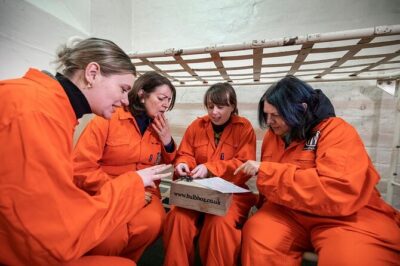



The Undead: Zombie Apocalypse Escape Room at Extreme Escape
Read our review →
Browse the lists this game appears in