

Review · PAYS DE LA LOIRE
Nantes: Outdoor Escape Game – Le défi de Jules Verne
Nantes becomes your game board. This two-hour outdoor escape game sends you across Île de Nantes with Jules Verne as your guide, or at least the story’s central problem. I like the mix of city discovery and puzzle solving, and I like that friends or family can work together at their own speed. The main caution is that the game seems strongest for patient, observant groups, not anyone expecting a polished theatrical show.
You meet outside Les Ateliers et Chantiers, then use a charged smartphone to follow clues and solve riddles. The French and English support is useful, and a game master is available throughout. Still, the experience earns a mixed 3.5 out of 5, with some players praising the chance to notice their surroundings and others finding the puzzles too simple or the phone-based format frustrating.
Key points to know before you book

- The story begins with Jules Verne returning to Nantes: You must repair a dangerous time problem and send him back to his own era.
- Île de Nantes is the main playing field: The game uses city streets and cultural spots rather than a locked room.
- Your smartphone is central: Bring it fully charged, since clues and conversations may arrive digitally.
- It works best with alert groups: One family of six enjoyed combining different clues, while another group found the riddles too easy.
- The price is $28 for up to two people: Check the current cost for a larger private group before paying.
- You have a two-hour window: That is enough for a focused outing, but delays, wandering, or low phone batteries can affect the finish.
Starting at Les Ateliers et Chantiers

The meeting point is outside the building called Les Ateliers et Chantiers. This gives the game a clear urban starting place on Île de Nantes, rather than asking you to search around a large square or museum for an unseen guide.
Arrive ready to begin outdoors. Transportation to the meeting point is not included, so you need to arrange your own way there. Food and personal expenses are also separate, although the activity lasts only two hours and does not include a meal stop.
The opening setup uses a Jules Verne time-travel story. After finding a way to travel through time, Verne appears in modern-day Nantes, his hometown. His sudden arrival threatens to create a serious problem across time, and your team must solve his riddles to send him back.
That plot gives the outing a local reason for existing. Jules Verne was born in Nantes, so the character belongs to the city rather than being pasted onto a random puzzle course. The story also fits an outdoor format: you are moving through the streets, looking for information, and piecing together clues as you go.
More Outdoor Escape Games in France
- Outdoor Escape Game in Étretat
★ 5.0 · 171 reviews - Lille: Outdoor Escape Game – Dans l’ombre d’Arsène
★ 3.9 · 37 reviews - Outdoor Escape Game in Paris : The Stone of Nicolas Flamel
★ 5.0 · 29 reviews
Following Jules Verne across Île de Nantes
The game takes place in the extraordinary Île de Nantes, an area with a strong cultural identity and plenty of modern city features. You are not simply handed a list of historical facts. Instead, you are asked to notice your surroundings while following a fictional problem.
That distinction matters. I like tours that make me look up from a map and pay attention to buildings, signs, public spaces, and small details. One of the clearest strengths here is the way the puzzles encourage observation. The game can turn a normal walk into a search for patterns and clues.
You should not expect a traditional guided tour with a guide speaking at each stop. The experience is built around solving tasks. The city provides the setting, while the Jules Verne story gives your group a reason to move from one clue to the next.
The exact route and puzzle sequence can depend on how your team progresses. You may pause to discuss a riddle, retrace a step, or compare the information on different phones. That can be fun for a group that enjoys working things out together. It can also feel slow if only one or two people are interested in solving every clue.
How the phone-based puzzles work

Bring a charged smartphone. This is not a minor suggestion. The game uses the phone for clues, guidance, and communication, and one group of six had complementary clues on different phones. That setup can encourage teamwork, since each person may have a slightly different piece of the puzzle.
The digital format appears to include chatbot-style conversations. A game master is available during the adventure, but the actual exchanges may be handled through a phone rather than by a person walking beside you. I would set your expectations accordingly. You are booking an interactive city puzzle, not a live performance with an actor in costume.
The best way to play is to make one person responsible for keeping the phone visible, while everyone else watches the street and discusses possible answers. If all the information stays with one player, the group can quickly turn into spectators. Sharing the screen and reading clues aloud should keep more people involved.
Battery life is important because the game can run for the full two hours. A dead phone can stop an otherwise good outing. Charge before you meet, reduce unnecessary phone use during the game, and consider bringing a small power bank if you have one.
The puzzle difficulty: friendly or too easy?
Puzzle difficulty is the biggest question mark. Some players enjoyed solving the riddles with their families and felt that the game encouraged careful observation. A family group specifically found the minimum age of 12 sensible for getting the most from the activity.
Other feedback was much harsher. One group found the riddles childish and said that the Jules Verne theme was not strongly present beyond occasional references and word searches. Another person felt the game was mainly a chatbot conversation with easy puzzles and limited variation between players.
Both reactions can be true for different groups. If you enjoy gentle clues, city walks, and the satisfaction of spotting details, the level may feel pleasant. If you regularly play advanced escape rooms and want layered logic, surprising mechanisms, or difficult deductions, you may find the game underpowered.
I would book this for a family, a casual group of friends, or visitors who want a structured walk. I would hesitate if your main goal is a serious escape-room challenge. The game is more about noticing and discussing than cracking complicated codes.
Same place, a different puzzle:
- Saw2 vs Squid Game – Escape Game Montpellier
★ 5.0 · 752 reviews - Prison Break – Escape game in Montpellier
★ 5.0 · 583 reviews - School of Magic – Escape game Montpellier
★ 4.5 · 536 reviews - Mission Possible – Escape game Montpellier
★ 5.0 · 437 reviews
What makes the Jules Verne theme work
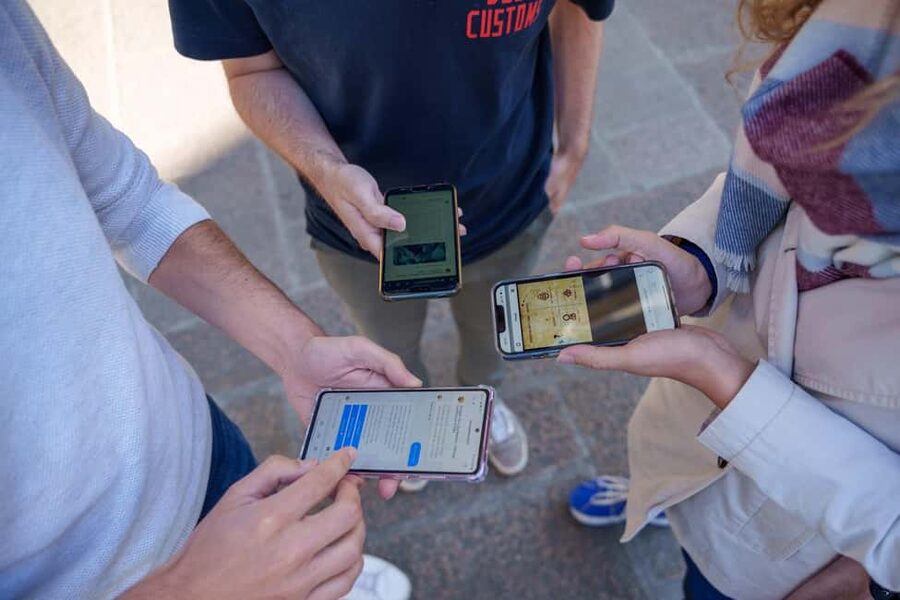
The Jules Verne idea is the experience’s best hook, but it may not dominate every moment. The central story is clear: Verne has arrived in the wrong time, and your team must help correct the problem. The use of books and searches for words gives the theme some physical and literary flavor.
Still, do not expect a full Jules Verne museum experience. The activity does not promise a detailed biography, a visit to a dedicated Verne site, or extended interpretation of his novels. The character functions mainly as the reason for the mission.
That is not necessarily a flaw. A city game needs a simple plot that keeps the group moving. The problem comes if you book it expecting every clue to connect closely to Verne’s life and writing. Based on the available feedback, the theme can feel more like a frame around the puzzles than the substance of every puzzle.
I would think of Jules Verne as a story guide, not a specialist history lesson. You get a playful link to Nantes and its famous son, while the real activity is reading clues and making sense of the city around you.
Exploring Nantes without a standard tour script
I like the freedom of an outdoor game because you experience Nantes while doing something active. You are not sitting through a long explanation or following a guide holding a flag. Your attention moves between the phone, the street, and your teammates.
The drawback is that the learning can be uneven. A standard walking tour controls the pace and explains why a place matters. Here, you may pass a cultural spot while concentrating on an answer. If your group gets stuck, the historical setting can become background scenery.
You can improve the experience by pausing after a clue and looking around before rushing to the next task. Notice the area, discuss what you are seeing, and use the game as a prompt to explore rather than as a race. This approach suits the game’s strongest quality, which is making you more observant.
The competitive option is flexible. Your group can compete against other teams or simply play for fun. I would choose the relaxed option for a family or mixed-age group. Competition can add energy, but it can also make a modest puzzle feel more stressful than it needs to be.
Group size, ages, and teamwork
The activity is sold as a private group experience. That is helpful if you want to keep the outing among friends or family rather than being paired with strangers. A group of six has completed it together, with different phones providing complementary clues.
For a larger group, divide jobs. One person can read the latest instruction, another can watch for environmental clues, and another can track possible answers. Give younger players a real role rather than letting adults solve everything on the phone.
The suggested minimum age of 12 makes sense for groups that want to solve the clues seriously. Younger children might still enjoy the story and the walk, but the game may not hold their attention for two hours if the riddles are too text-heavy or abstract.
Adults should also be honest about their own interests. This is not an activity where everyone automatically stays engaged. One negative experience involved a six-person group in which several people lost interest while only two continued. A team that enjoys chatting, looking carefully, and trying multiple ideas will get more from it than a group hoping for constant action.
Is $28 good value?
The advertised price is $28 per group of up to two people. At that rate, it can be reasonable for a two-hour private activity in central Nantes, especially when you value the freedom to play at your own pace and the chance to see Île de Nantes in a different way.
The value becomes less clear if your group is larger or if you compare it with a live guided walk. Confirm the current price for your party before booking, since the stated rate covers up to two people. One piece of feedback specifically advised paying only for two, while another person felt the experience was expensive for what it offered.
That disagreement points to the real value test. If your group enjoys the puzzles, the price buys a planned outing, a city-based story, digital clues, and game-master support. If the clues feel basic and the phone conversation feels repetitive, the same price can seem high.
I would not book this solely because it is cheaper than a standard tour. Book it because your group wants to play a game while walking around Nantes. The format, not the amount of historical explanation, is what you are paying for.
Practical ways to make the outing better

A little preparation can prevent the most common frustrations.
- Charge every phone that will be used.
- Decide before starting who will read clues and who will watch the surroundings.
- Keep the group together unless the instructions clearly tell you otherwise.
- Give everyone a chance to suggest answers.
- Allow time to stop and observe instead of racing from clue to clue.
- Use the French or English support that suits your group.
- If you dislike chatbot-style interaction, ask yourself if a phone-led game is the right format.
- Check the meeting point carefully, since you arrange your own transportation.
The game master is available throughout, which should help if your team needs guidance. Still, I would not assume that every issue will be solved instantly by a person standing nearby. The activity appears designed for your group to manage much of the process through the phone.
There is also a practical concern around construction or access. One negative experience reported clues in areas that were difficult to reach because of works. Conditions in a city can change, so if your route meets a barrier, contact the available support rather than wasting time trying to reach an inaccessible clue.
Who should book this Nantes game?
I think this fits families with older children, casual escape-game fans, and friends who want a reason to explore Île de Nantes. It is especially suitable if you enjoy word searches, light riddles, and talking through possible answers as you walk.
It may also suit visitors who have already seen Nantes in a conventional way and want a different structure for an afternoon. The game gives you a mission, which can make an unfamiliar area easier to approach.
I would be cautious for serious escape-room players, visitors seeking detailed local history, or anyone who dislikes using a phone during an activity. The mixed reactions to puzzle difficulty are worth taking seriously. Some people find the clues enjoyable and observant, while others find them too simple to justify the cost.
The experience has received a mixed 3.5 out of 5 overall, with several strong ratings for family fun and attention to surroundings, alongside sharp criticism about theme depth, puzzle quality, and value. That makes it a selective recommendation rather than an automatic one.
Should you book the Jules Verne challenge?
Book it if you want a private, two-hour city game with a light Jules Verne plot and a chance to explore Île de Nantes while solving clues. Bring a charged phone, keep your expectations moderate, and choose teammates who enjoy observation and discussion.
Skip it if you want a demanding escape room, a live theatrical guide, or a detailed Jules Verne history lesson. For the right group, it can turn a walk into a pleasant shared challenge. For the wrong group, it may feel like an expensive chatbot session with easy riddles.
FAQ
Where does the outdoor escape game start?
It starts outside in front of the building called Les Ateliers et Chantiers in Nantes.
How long does the experience last?
The adventure lasts two hours.
What is the Jules Verne story about?
Jules Verne has used time travel to arrive in modern-day Nantes, creating a serious space-time problem. Your team must solve his riddles and send him back to his own time.
Is the activity indoors or outdoors?
It is an outdoor escape game that takes place through the streets and cultural areas of Île de Nantes.
Do I need a smartphone?
Yes. You should bring a charged smartphone for the game.
Is the experience available in English?
Yes. French and English are available.
Is the group private?
Yes. The activity is offered as a private group experience.
Can I cancel for a full refund?
Yes. You can cancel up to 24 hours in advance for a full refund.
Just added around France
- Historical treasure hunt in the city of Versailles★ 4.0 · 15 reviews
- Outdoor escape game | The Minotaur★ 4.5 · 2 reviews
- Escape game outdoor The Walking Dead in Tours★ 3.0 · 2 reviews
- Romantic Toulouse: Self-Guided Love Story Puzzle Walk★ 4.0 · 2 reviews
- Discover Toulouse while playing! Escape game – The alchemist★ 3.5 · 4 reviews
- Tours: Magic Team Escape Game in Town★ 3.0 · 2 reviews
- Urban escape game in Toulouse – Crazytopia★ 3.0 · 3 reviews
- Unusual treasure hunt at the Christmas markets in Strasbourg★ 5.0 · 9 reviews
Outdoor Escape Games, compared.


Game of Thrones Private Outdoor Escape Game in Dubrovnik
Read our review →
Discover Utrecht with a self-guided Outside Escape city game tour
Read our review →

Outdoor Escape Game Dubrovnik – The Spy And The Traitor (History theme)
Read our review →
Discover Amerfoort’s city center in this Outside Escape game tour
Read our review →Browse the lists this game appears in