
Review · BOLOGNA
Bologna Murder Mystery: Self-Guided City Quest
Bologna turns sightseeing into a puzzle. This one-hour city quest uses an app to guide you from Porta Galliera toward Piazza Rossini, sending you through markets, theaters, churches, university sites, and famous medieval towers. I like the freedom to begin whenever you choose, and I like that the game works without an internet connection once you have access to it.
The price is just $6 per person, which is hard to beat for a private activity shared only with your own group. The main drawback is that the mystery story may feel thinner than the sightseeing. You can also get turned around briefly, so this works best if you enjoy solving clues more than following a guide who points out every detail.
The best parts of this Bologna quest
- A low-cost way to see major sights: For $6, you get 11 puzzle challenges and a self-guided route through central Bologna.
- No fixed departure time: Start any time during the listed opening period, then pause and resume when it suits your group.
- A route packed with history: The quest includes Porta Galliera, Piazza Maggiore, the Two Towers, the Archiginnasio, and several important churches.
- Good for private groups: Only your group takes part, with no strangers or scheduled guide to keep pace with.
- Useful offline play: You do not need a live internet connection while solving the challenges, so the game should not consume mobile data as you walk.
- A playful option for families and friends: Looking for clues gives younger participants a reason to inspect buildings and monuments closely.
How the murder mystery works in Bologna
This is not a traditional walking tour with a guide waiting at a meeting point. You receive a mobile access code and use the Questo app to follow directions from the starting point at Piazza XX Settembre, 15.
The app leads you from one location to the next. At each stop, you look around for a detail that answers the current puzzle. Solve it, and the next location opens. The basic format is simple: walk, observe, solve, and continue.
That structure changes how you see Bologna. Instead of passing a gate or statue while thinking about lunch, you have a reason to inspect it. A date, shape, inscription, architectural detail, or nearby feature may become important. The game asks you to pay attention to things that are easy to miss on an ordinary stroll.
The activity includes 11 puzzle challenges, although the route takes in a larger set of landmarks. You should plan on about an hour, but the pause and resume feature gives you room to stop for coffee, browse a market, or continue later. The listed opening hours cover every day and all hours, so you are not tied to a morning meeting time.
This freedom is one of the strongest features. You can start before the city gets busy, fit the quest between museum visits, or use it as an evening walk. Since there is no physical guide, you also avoid the usual pressure to keep up with a group.
More Self-Guided App Games in Italy
- Florence Self-Guided Treasure Hunt & Medici Mystery Walking Tour
★ 5.0 · 69 reviews - Siena Medieval Power Quest: Self-Guided Family Feud Game
★ 4.5 · 38 reviews - Bologna Secrets Quest: Self-Guided Hidden Gems Adventure
★ 4.0 · 24 reviews
Porta Galliera and the first clues
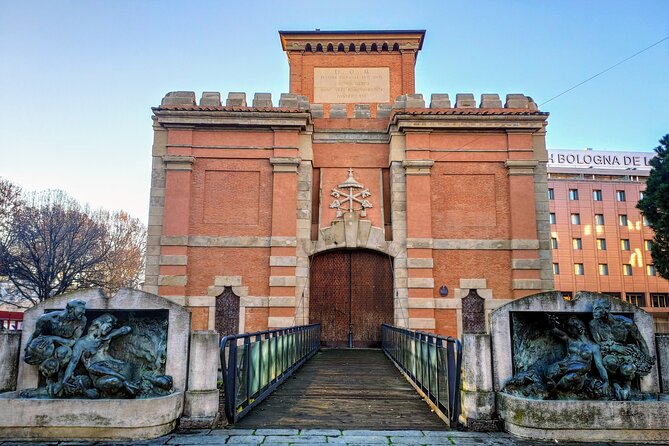
Porta Galliera is a fitting place to begin. It was one of the gates in Bologna’s former outer medieval walls and is the most ornamented of the surviving gates. The present gate was built between 1659 and 1661, based on designs by Bartolomeo Provaglia.
Here, the quest asks you to search for the answer rather than simply read a paragraph of background. That small change matters. You need to study the gate and its surroundings, which makes the first stop feel like a proper challenge instead of a picture-taking pause.
The starting point at Piazza XX Settembre is near public transportation, so reaching the beginning should be fairly straightforward. Still, you should enter the correct starting address carefully. The app gives step-by-step directions, and following them closely is important if you want the route to flow without confusion.
Piazza VIII Agosto and Bologna’s market life
The next part brings you to Piazza VIII Agosto, known for its large Piazzola market on Fridays and Saturdays. More than 400 street stalls fill the area on those days.
The market can add extra energy to this challenge. You may need to look closely among stalls and people to find the clue, which makes the puzzle feel connected to daily city life rather than sealed inside a museum. It is also a reminder that Bologna is more than its grand churches and porticoes.
The tradeoff is obvious: a crowded market can make a visual clue harder to spot. If your group includes children, this may be fun. If you prefer quiet sightseeing, choose a less busy time or expect to spend a little longer checking the area.
Arena del Sole and a theater stop
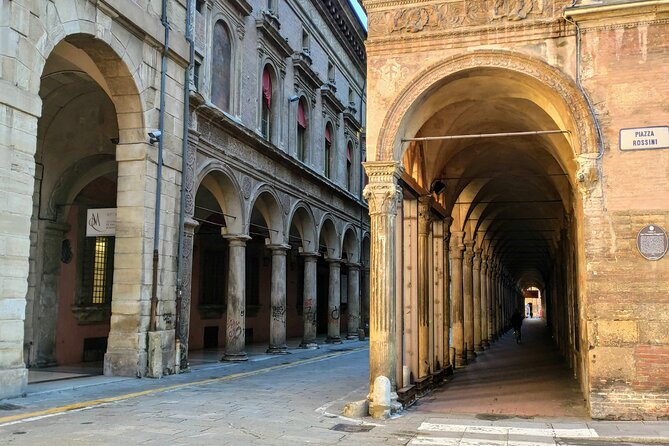
Arena del Sole is one of Bologna’s historic theaters. Its origins reach back to 1810, and the theater reopened in 1995 after eight years of reconstruction.
This stop gives the route a welcome change of pace. You move from civic walls and market stalls to a place tied to performance and public entertainment. The puzzle format encourages you to look at the building itself and learn why it matters.
Do not expect a theater visit as part of the $6 experience. The quest takes you to the site and uses it as a clue location. The value is in seeing a piece of Bologna’s cultural life while walking between larger headline sights.
More Murder Mystery Games in Italy:
- Bologna Sherlock Holmes Murder Mystery Game
★ 3.0 · 3 reviews - Branson Murder Mystery- Branson’s Original #1 Murder Mystery
★ 5.0 · 1,513 reviews - Riga Tony’s Murder Mystery Dinner Show
★ 4.5 · 537 reviews - WhoDunnit Hoedown – Branson’s Best Murder Mystery Dinner Show
★ 4.5 · 493 reviews
Neptune, Piazza Maggiore, and the city center
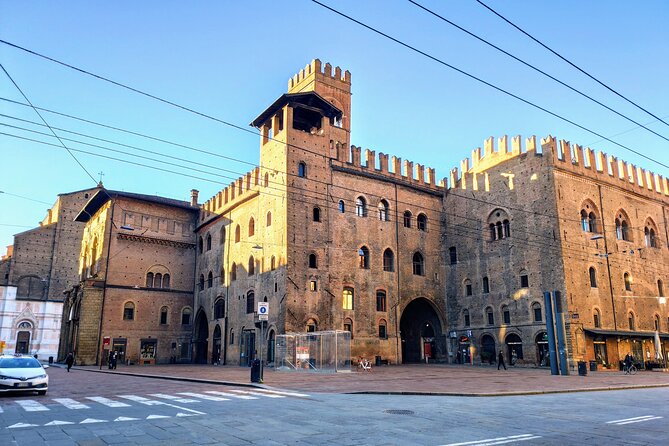
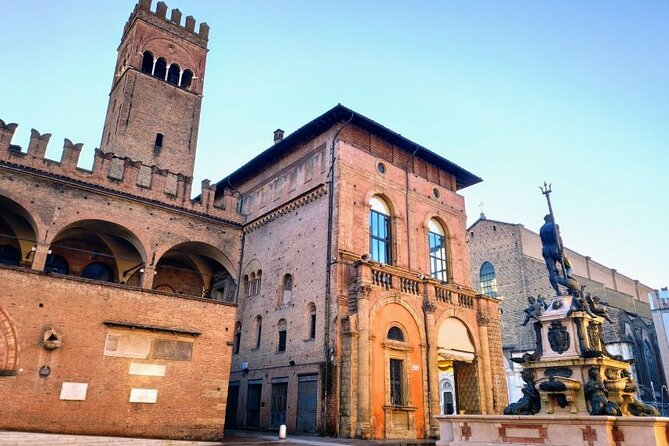
The Fountain of Neptune is one of the route’s most recognizable stops. It was completed in 1565, while the oversized bronze figure was finished and placed around 1567. The statue was an early design by Giambologna, who had also submitted a model for Florence’s Fountain of Neptune but lost that commission to Baccio Bandinelli.
This is the kind of place where a self-guided puzzle works well. The fountain offers plenty for you to examine, and the app turns careful looking into progress. You can pause after solving the clue to take in the monument, but the activity itself does not promise a long art lecture.
The route then reaches the oratory built between 1481 and 1497 by the Celestine fathers of the nearby church of San Giovanni Battista. The small church was built in an area connected with an ancient image of the Madonna, protected by a simple tabernacle.
This stop rewards curiosity. It is less obvious than a major piazza, and the quest gives you a reason to notice it. That is one of the most useful things about the experience: it links famous places with smaller religious buildings that could otherwise pass unnoticed.
San Petronio and Bologna’s unfinished facade
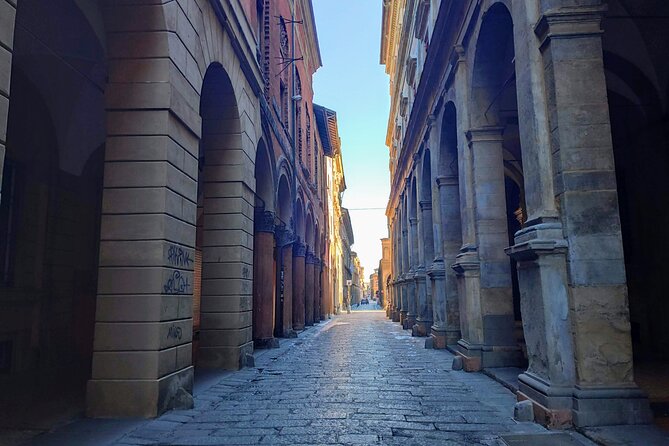
The Basilica of San Petronio dominates Piazza Maggiore. It is dedicated to Saint Petronius, Bologna’s fifth-century bishop and patron saint. Construction began in 1390, but the main facade remains unfinished.
That unfinished front is not a flaw to explain away. It is part of the building’s identity and one of the most memorable details in the square. The quest asks you to inspect the basilica and use what you see to solve the next challenge.
You should allow extra time here if you want to appreciate the church properly. The game is designed to keep you moving, and an hour is a short time for Bologna’s central monuments. I would treat this activity as an introduction, not a substitute for returning to Piazza Maggiore on your own.
The church with Niccolò dell’Arca’s famous sculpture
Another church on the route began in its present Baroque form between 1687 and 1690, based on designs by Giovanni Battista Bergonzoni. Its elliptical plan has a dome designed by Giuseppe Tubertini, completed in 1787, while the facade was added in 1905.
Inside, the sanctuary houses Sorrow over Dead Christ, a sculptural group from 1463 by Niccolò dell’Arca. That detail gives this stop real weight. You are not just being sent from one attractive building to another. You are being led toward a work that is important in its own right.
The app may offer enough information to identify the location and move the story forward, but you should not expect the depth of a specialist art tour. If the sculpture is open and accessible during your visit, consider spending extra time there after completing the clue.
The Two Towers and medieval Bologna
The taller tower is the Asinelli, while the shorter and more dramatically leaning tower is the Garisenda. Their names come from the Asinelli and Garisenda families, traditionally credited with having the towers built between 1109 and 1119.
These towers make a strong puzzle stop because their shapes are so distinctive. You can understand the clue quickly, but the real reward is seeing how strongly medieval Bologna still shapes the city center.
The route does not include a promise of tower entry or a climb. Treat this as an exterior sightseeing stop. The Two Towers are a useful landmark for orientation, too, especially if the app briefly leaves you uncertain about which street to take next.
The university, Montagnola, and Bologna’s public spaces
Bologna’s university is the oldest in Europe, but it did not have a permanent base until well into the Renaissance. Before that, classes took place in professors’ homes or public spaces, including areas near this route.
That history gives the university stop a human scale. Instead of thinking only about a grand institution, you can picture teachers and students using ordinary city spaces for lessons. It also helps explain why Bologna’s center feels so closely tied to learning.
The Park of Montagnola offers a different setting. It was originally constructed in 1805 under Napoleonic rule, with the design commissioned from Giovanni Battista Martinetti.
Because the quest covers both academic and public spaces, the walk does not feel like a string of churches. Montagnola gives you a park setting and a pause from dense streets. The amount of time you spend there will depend on how quickly your group solves the clue and how much you want to look around.
Bologna Cathedral and the Archiginnasio
Bologna Cathedral, dedicated to Saint Peter, is the city’s cathedral and the seat of the Archbishop of Bologna. Most of the current building dates from the seventeenth century, with some sections from the late sixteenth century.
This is another stop where the game helps you build a mental map of central Bologna. You encounter a major religious building, then continue toward the institutions that shaped the city’s intellectual life.
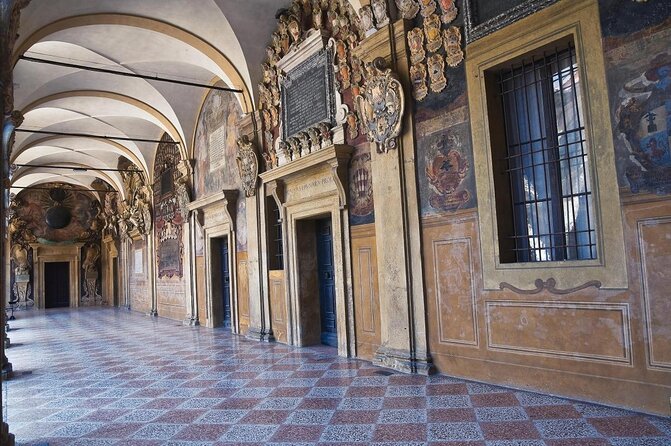
The Archiginnasio was begun at the end of February 1562 and completed so quickly that it opened on October 21, 1563. It was built as the new home of the university, whose earlier name was the Studium.
For me, this is one of the most valuable parts of the route. The Archiginnasio connects the earlier story of classes held in homes and public places with a purpose-built university building. The quest gives you a compact introduction to that change, even if it cannot cover every detail in an hour.
Palazzo dei Banchi and the finish at Piazza Rossini
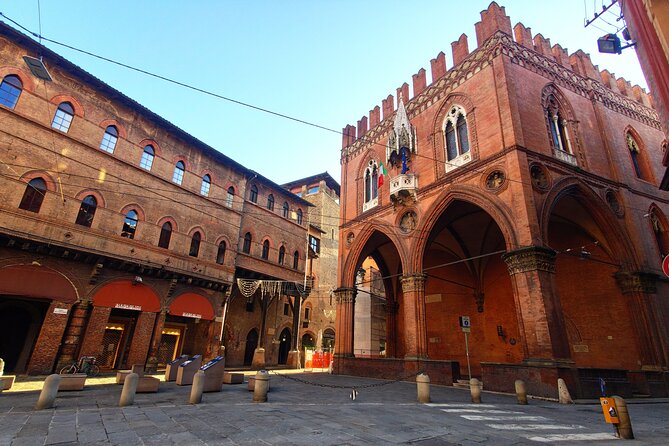
Palazzo dei Banchi was the last building erected in Piazza Maggiore. Vignola designed its sixteenth-century facade to hide the narrow alleys of the market behind it. Its name refers to the currency exchange banks once found there.
This is a smart final area for a city quest because it brings together architecture, commerce, and the old market district. The facade is not just decoration. It was built to solve a city problem by giving the square a more unified appearance.
The route ends at Piazza Rossini, 1. The app guides you there step by step, so you should follow the directions closely rather than assume the final stop is obvious. The ending is not a staffed meeting point, and no physical guide will be waiting for you.
What $6 gets you
At $6 per person, the value is strong if you want an inexpensive activity that combines walking with simple puzzles. You receive mobile access, 11 challenges, a mystery storyline, real-world clues, and the ability to pause and resume.
A normal guided walk would usually offer more explanation and the chance to ask questions. This quest offers something different: a private route at a very low cost. You are paying for a framework that helps you explore, not for an expert who interprets every facade.
The private format also improves the value for families and groups of friends. You can move at your own speed, discuss answers openly, and avoid joining strangers. Group discounts may make the cost even lower for larger parties, though the exact discount should be checked when booking.
The main weakness: story versus sightseeing
The murder mystery is a useful reason to walk, but you should keep your expectations in check. The puzzle structure is likely to be the strongest part of the game, while the plot may feel less clear or less satisfying than the route itself.
One player found the story did not fully make sense but still considered the game a pleasant way to spend about an hour. That is a fair way to judge it. If you need a tightly written mystery with a rich series of reveals, this may disappoint. If you mainly want an interactive walk with a bit of suspense, the story does its job.
You may also get lost briefly. The route is app-based, and no guide is present to correct you in person. The good news is that the puzzles and directions can help you find your way again, but you should not rush.
Who should book this experience?
I would recommend it most strongly to families with older children, couples who like puzzles, and groups of friends who want a low-cost activity between meals and museum visits. It is also useful for first-time visitors who want to cover many central landmarks without committing to a fixed tour schedule.
It is less suitable if you want a full historical explanation, a professional guide, or entry into the churches and buildings along the route. You may also prefer a conventional walk if you dislike using your phone while sightseeing.
The activity is offered in English. Service animals are allowed, most people can participate, and the route is near public transportation. Since the experience is private, only your own group takes part.
You receive confirmation when booking. Free cancellation is available if you cancel at least 24 hours before the local start time. Cancellations within 24 hours are not refunded, and last-minute changes are not accepted.
Should you book the Bologna Murder Mystery?
Book it if you want a cheap, flexible way to see Bologna while solving clues. The route covers an impressive set of central landmarks, from Porta Galliera and the Two Towers to San Petronio, the Archiginnasio, and Palazzo dei Banchi.
Skip it if you want a guide’s voice, detailed art history, or a carefully developed crime story. For everyone else, $6 buys a pleasant hour of walking, looking closely, and learning facts you might otherwise miss. Start with a charged phone, follow the app carefully, and leave time to revisit the sights that catch your eye.
FAQ
How long does the Bologna Murder Mystery take?
The experience takes approximately one hour. You can pause and resume it, so your total time can be longer if you stop along the route.
Where does the experience start?
It starts at P.za XX Settembre, 15, 40121 Bologna BO, Italy.
Where does the experience end?
It ends at P.za Rossini, 1, 40126 Bologna BO, Italy. The Questo app provides step-by-step directions to the ending point.
Is a physical guide included?
No. The experience is self-guided through the Questo app, and no physical tour guide is included.
Do I need an internet connection during the game?
No internet connection is needed to play, so you should not use mobile data while completing the challenges.
What is included in the price?
The price includes mobile access, 11 puzzle challenges, an immersive mystery storyline with real-world clues, and the ability to pause and resume the experience.
More City Exploration Games in Italy
- Florence Inferno: Dante’s Haunted Exploration Game and Tour
★ 4.5 · 33 reviews - Florence Haunted Secrets: Echoes of the Dead Exploration Game
★ 4.0 · 9 reviews - Ghosts of Turin: Hidden Spell Exploration Game
★ 3.5 · 8 reviews - Trieste Exploration Game and City Tour on your Phone
★ 5.0 · 3 reviews
Just added around Italy
- Verona Scavenger Hunt and Highlights Self Guided Tour★ 4.0 · 17 reviews
- Verona Scavenger Hunt and Highlights Self Guided Audio Tour★ 4.5 · 7 reviews
- Venice Highlights Self Guided Scavenger Hunt and Walking Tour★ 4.0 · 6 reviews
- Carnival Treasure Hunt & Mask Painting Workshop★ 4.5 · 7 reviews
- Venice Cannaregio Scavenger Hunt and Sights Self-Guided Tour★ 3.5 · 3 reviews
- Venice: Casanova Charm Carnival Treasure Hunt★ 4.5 · 9 reviews
- Turin Scavenger Hunt and Sights Self-Guided Tour★ 5.0 · 2 reviews
- Ghosts of Turin: Hidden Spell Exploration Game★ 3.5 · 8 reviews
Murder Mystery Games, compared.

Branson Murder Mystery- Branson’s Original #1 Murder Mystery
Read our review →

WhoDunnit Hoedown – Branson’s Best Murder Mystery Dinner Show
Read our review →
Ancient Greek Theatre Murder Mystery Experience
Read our review →
Interactive Jack the Ripper Night Walk: London’s Murder Mystery
Read our review →Ancient Greek Theatre Murder Mystery Experience
Read our review →
Colombia’s Finest Outdoor Murder Mystery London
Read our review →Browse the lists this game appears in